

Do you know:: the sisters who witnessed H-bomb tests on their Pacific island and are still coming to terms with the fallout in 2024
Nuclear detonations were the backdrop to Teeua and Teraabo’s childhood. By the time the sisters were eight and four, the Pacific island on which they grew up, Kiritimati, had hosted 30 atomic and thermonuclear explosions – six during Operation Grapple, a British series between 1957 and 1958, and 24 during Operation Dominic, led by the US in 1962.
The UK’s secretary of state for the colonies, Alan Lennox-Boyd, had claimed the Grapple series would put Britain “far ahead of the Americans, and probably the Russians too, in super-bomb development”. Grapple, the country’s largest tri-service operation since D-Day, also involved troops from Fiji and New Zealand. It sought to secure the awesome power of the hydrogen bomb: a thermonuclear device far more destructive than the atomic bomb.
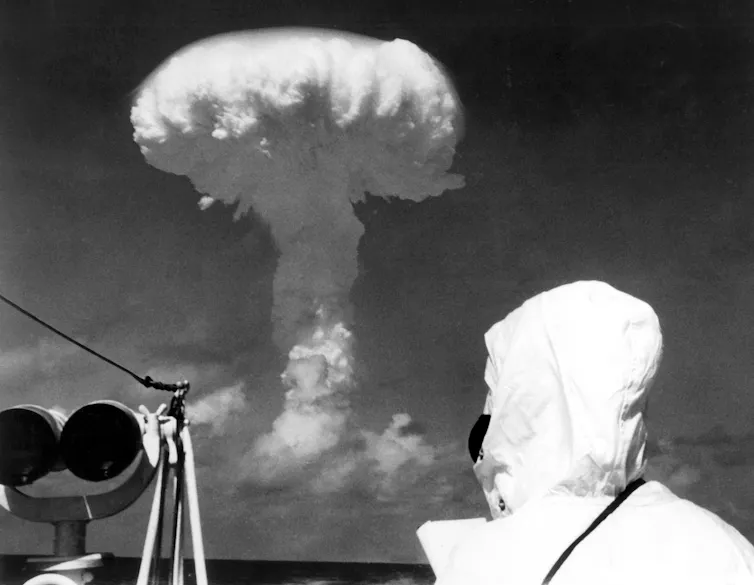
Britain’s seat at the top table of “super-bomb development” was emphatically announced in April 1958 with Grapple Y: an “H-bomb” 200 times more powerful than the bomb dropped on Hiroshima in 1945. This remains Britain’s largest nuclear detonation – one of more than 100 conducted by the UK, US and Soviet Union in 1958 alone.
More than six decades later, the health effects on former servicemen based on Kiritimati, as well as at test locations in South and Western Australia, remain unresolved. Greater Manchester’s mayor, Andy Burnham, has called the treatment of UK nuclear test veterans “the longest-standing and, arguably, the worst” of all the British public scandals in recent history.
Read more:
Nobel peace prize awarded to Japanese atomic bomb survivors’ group for its efforts to free the world of nuclear weapons
Unlike the Post Office, infected blood and Grenfell Tower inquiries in 2024, there has been no UK inquiry into British nuclear weapon tests in Australia and the Pacific. Yet veterans and their descendants maintain these tests caused hereditary ill-health effects and premature deaths among participants. The British government has been accused of hiding records of these health impacts for decades behind claims of national security.
Over the past year, the life stories of British nuclear test veterans have been collected by researchers, including myself, for an oral history project in partnership with the British Library. Whether from a vantage point of air, land or sea, the veterans all recall witnessing nuclear explosions with startling clarity, as if the moment was seared on to their memories. According to Doug Herne, a ship’s cook with the Royal Navy:
When the flash hit you, you could see the X-rays of your hands through your closed eyes. Then the heat hit you, and it was as if someone my size had caught fire and walked through me. To say it was frightening is an understatement. I think it shocked us into silence.
But what of the experiences of local people on Kiritimati? I have recently interviewed two sisters who are among the few surviving islanders who witnessed the nuclear tests. This is their story.
‘A mushroom cloud igniting the sky’
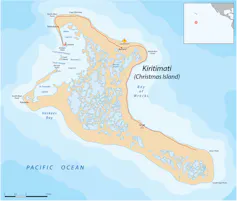
At the start of Operation Grapple in May 1957, around 250 islanders lived on Kiritimati – the world’s largest coral reef atoll, slap bang in the centre of the Pacific Ocean, around 1,250 miles (2,000km) due south of Hawaii. The island’s name is derived from the English word “Christmas”, the atoll having been “discovered” by the British explorer James Cook on Christmas Eve 1777.
In May 2023, I visited Kiritimati for a research project on “British nuclear imperialism”, which investigated how post-war Britain used its dwindling imperial assets and resources as a springboard for nuclear development. I sought to interview islanders who had remained on the atoll since the tests, including Teeua Tekonau, then aged 68. In 2024, I visited her younger sister, Teraabo Pollard, who lives more than 8,000 miles away in the contrasting surroundings of Burnley, north-west England.
Far from descriptions of fear and terror, both Teeua and Teraabo looked back on the tests with striking enthusiasm. Teraabo recalled witnessing them from the local maneaba (open-air meeting place) or tennis court as a “pleasurable” experience full of “excitement”.
She described having her ears plugged with cotton wool before being covered with a blanket. As if by magic, the blanket was then lifted to reveal a mushroom cloud igniting the night sky – a sight accompanied by sweetened bread handed out by American soldiers. So vivid was the light that Teraabo, then aged four, described “being excited about it being daytime again”.
In view of the violence of the tests, I was struck that Teeua and Teraabo volunteered these positive memories. Their enthusiasm seemed in marked contrast to growing concerns about the radioactive fallout – including those voiced by surviving test veterans and their descendants. As children, the tests seem to have offered the sisters a spectacle of fantasy and escapism – glazed with the saccharine of American treats and Disney films on British evacuation ships.
Yet they have also lived through the premature deaths of family members and, in Teraabo’s case, a malignant tumour dating from the time of the tests. And there have been similar stories from other families who lived in the shadow of these very risky, loosely controlled experiments. Teraabo told me about a friend who had peeked out from her blanket as a young girl – and who suffered from eye and health problems ever since.
‘Only a very slight health hazard’
Kiritimati forms part of the impossibly large Republic of Kiribati – a nation of 33 islands spread over 3.5 million square kilometres; the only one to have territory in all four hemispheres and, until 1995, on either side of the international date line. Before independence from Britain in 1979, Kiribati belonged to the Gilbert and Ellice Island Colony, which in effect made Kiritimati a “nuclear colony” for the purpose of British and American testing.
Panther Media/Alamy.
In 1955, Teeua and Teraabo’s parents, Taraem and Tekonau Tetoa, left their home island of Tabiteuea, a small atoll belonging to the Gilbert group of islands in the western Pacific. They boarded a British merchant vessel bound for Christmas Island nearly 2,000 miles away. Setting sail with new-born Teeua in their arms, the family looked forward to a future cutting copra on Kiritimati’s British coconut plantation.
The scale of this journey, with four young children, was immense. Just how the hundred or so Gilbertese passengers “managed to live [during the voyage] was better not asked”, according to one royal engineer who described a similar voyage a few years later. “There were piles of coconuts everywhere – perhaps they were for both food and drink.”

Within two years of their arrival, the family faced more upheaval as mother Taraem and her children were packed aboard another ship ahead of the first three sets of British nuclear tests in the Pacific. Known as Grapple 1, 2 and 3, they were to be detonated over Malden Island, an atoll some 240 miles to the south of Kiritimati – but still too close for the comfort of local residents.
According to Teeua, the evacuation was prompted by disillusioned labourers brought to Kiritimati without their families, who went on strike after learning how much the British troops were being paid. But the islanders’ perspectives do not feature much in the colonial records, which give precedence to British disputes about logistical costs and safety calculations.
The Grapple task force resolved that the safe limit set by the International Commission on Radiological Protection should be reduced, to limit the cost of evacuations. A meeting in November 1956 noted that “only a very slight health hazard to people would arise from this reduction – and that only to primitive peoples”.
Shocking as this remark sounds, it is typical of the disregard that nuclear planners appear to have had, both for Indigenous communities and the mostly working-class soldiers. These lives did not seem to matter much in the context of Britain’s quest for nuclear supremacy. William Penney, Britain’s chief nuclear scientist, had bemoaned how critics during tests in Australia were “intent on thwarting the whole future of the British Empire for the sake of a few Aboriginals”.
Smith Archive/Alamy Stock Photo
Tekonau, Teeua’s father, was one of the 30 or so I-Kiribati people to stay behind on Kiritimati during the Malden tests in May and June 1957. As one of the only labourers to speak English, he had gained the trust of the district commissioner, Percy Roberts, who invited Tekonau to accompany him during inspections of villagers’ houses in Port London, then the island’s only village. On one occasion, Teeua said, the islanders did not recognise her father as he had been given a “flat top” haircut like the Fijian soldiers. “This means he had a nice relationship with the soldiers,” she told me. “Thank God for giving me such a good and clever dad.”
Since the initial tests did not produce a thermonuclear explosion, the task force embarked on further trials between November 1957 and September 1958, known as Grapple X, Y and Z. In view of expense and time, these were conducted on Kiritimati rather than Malden Island – and this time, the residents were not evacuated to other islands. Rather, families were brought aboard ships in the island’s harbour and shown films below deck.
After these tests, the islanders returned to find the large X and Y detonations had cracked the walls of their homes and smashed their doors and furniture. One islander found their pet frigate bird, like so many of the wild birds on Kiritimati, had been blinded by the flash of Grapple Y. No compensation was ever paid to the islanders, although the Ministry of Supply did reimburse the colony for deterioration of “plantation assets”, including £4 for every damaged coconut tree (equivalent to £120 today).
A month before Grapple Y, Teraabo was born. Her earliest and most vivid childhood memories are of the US-led Operation Dominic four years later, by which time evacuation procedures had been abandoned altogether.
This series of tests was sanctioned by Britain in exchange for a nuclear-powered submarine and access to the Nevada Proving Grounds in the US – regarded as pivotal to the future of British weapons technology ahead of the signing of the Test Ban Treaty in October 1963, which would prohibit atmospheric testing.
Dominic’s 24 detonations on Kiritimati – which usually took place after sunset around 6pm, between April and November 1962 – were “awesome”, according to Teraabo. Recalling the suspense as the “tannoy announced the countdown”, she described “coming out of cover [and] witnessing the bomb [as] an amazing experience … When the bomb set off, the brilliance of the light was tremendous.”
 HMN 2025: How Almost half of all nursing home staff in Norway have witnessed elder abuse by relatives