

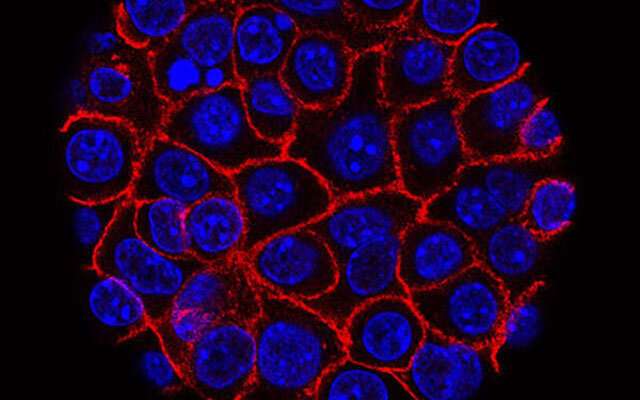
Many advanced cancers develop resistance to treatment and become highly aggressive, often leaving patients with limited treatment options. In some cancers, including lung, pancreatic and prostate tumors, a key driver of treatment resistance and metastasis is a protein called integrin ?v?3, which is absent in normal tissues but enriched in aggressive tumors.
Previous attempts to target ?v?3 with antibody therapies worked by activating a specific type of cell in the immune system called natural killer cells, but this approach ultimately failed to significantly improve patient survival in clinical trials, potentially because the tumors didn’t have enough natural killer cells to mount a strong immune response.
Now, researchers at University of California San Diego School of Medicine have developed a new approach that overcomes this barrier by taking advantage of the tumor’s own immune landscape. The study was published in Molecular Cancer Therapeutics.
By engineering a new anti-?v?3 antibody that activates macrophages—a type of immune cell already abundant in advanced ?v?3+ tumors—the researchers were able to trigger powerful anti-tumor responses in both patient tumor samples and in mouse models.
Key findings include:
- In both patient tumor samples and mouse models, the new antibody killed cancer cells more effectively than the older version, leading to increased tumor cell death and reduced tumor growth.
- The antibody reprogrammed macrophages to attack tumors by increasing levels of inducible nitric oxide synthase (iNOS), a critical enzyme that helps the immune system kill cells that are infected or cancerous.
- The anti-tumor effect depended entirely on macrophages; when macrophages were depleted, the therapy lost its effectiveness, while depletion of natural killer cells had no impact.
The results suggest that customizing antibody therapies to target the dominant immune cells present in a given tumor could dramatically improve outcomes for patients with aggressive, drug-resistant cancers. Further, because integrin ?v?3 is absent from healthy tissues, the new antibody is highly selective and will have no negative impact on surrounding cells, making it a potentially safer alternative to conventional therapies.
The researchers believe that their antibody optimization strategy could serve as a blueprint for treating other treatment-resistant tumors, potentially improving a wide range of existing immunotherapies and offering new hope for patients with advanced cancers.
The study was led by Hiromi I. Wettersten, M.D., Ph.D., assistant professor in the Department of Pathology at UC San Diego School of Medicine and member of UC San Diego Moores Cancer Center.
More information:
Molecular Cancer Therapeutics (2025). aacrjournals.org/mct/article-a … 535-7163.MCT-25-0300
The content is provided for information purposes only.