

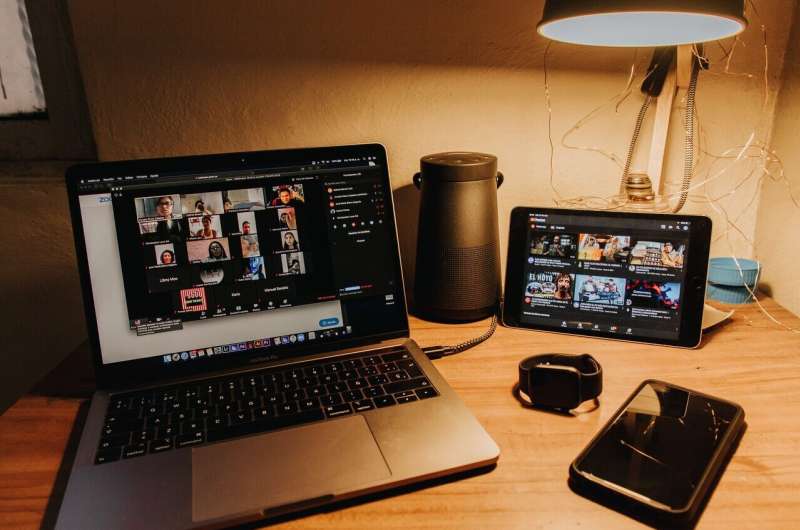
Online meetings are exhausting—this phenomenon, dubbed “zoom fatigue,” was widely reported in the media during the COVID-19 pandemic. “And this was certainly what happened during lockdown,” points out Junior Professor Hadar Nesher Shoshan of Johannes Gutenberg University Mainz (JGU). “But we have found out by means of a recent study that this is no longer the case under the conditions that prevail today. In fact, it seems that video meetings are not more exhausting than face-to-face meetings.” The results of the study are published in the Journal of Occupational Health Psychology.
With the help of a collective of 125 subjects, Shoshan, together with Assistant Professor Wilken Wehrt from Maastricht University, investigated how exhausting online meetings are in comparison with other forms of meeting. They asked the subjects to report over a period of 10 days on the following aspects: If they had taken part in a meeting, whether that meeting was online or face-to-face and whether they were dealing with other things during the meeting. They were also asked if there had been the opportunity to take a break or stretch their legs and how exhausted the meeting had made them feel. This enabled the researchers to collect information on 945 meetings, of which 62% were video meetings.
“Our initial hypothesis was that zoom fatigue still existed. After all, all previous studies had come to this conclusion, so there was no reason to doubt that this result was correct,” adds Shoshan. “However, we found no evidence of the phenomenon. According to our findings, online meetings are not more fatiguing than in-person meetings.”
In fact, the researchers report that video meetings shorter than 44 minutes are actually less exhausting than other meetings.
Previous studies based on data collected during the pandemic
The question is how this discrepancy in results of the new and the former studies came about. Shoshan postulates that this is because the study she undertook with her colleague uses data collected recently, while the other studies employed data collated during the COVID-19 pandemic.
She goes on to explain, “It is more likely that the cause of zoom fatigue was the pandemic situation itself rather than the online meeting conditions. Projected onto zoom meetings, linked as they were closely with lockdown, were all the negative aspects associated with the circumstances. People were missing their old way of life, their social contacts and were no longer enjoying their work. Our results highlight the importance in the social sciences of replicating research findings in the appropriate historical setting.”
Shoshan believes that their new findings have important practical implications with regard to the working world, particularly when it comes to the assumed “disadvantages” of working from home. “We have been able, at least to some extent, to undermine the argument that online meetings while working from home can still cause burn-out among personnel even though the pandemic is over.”
More information:
Hadar Nesher Shoshan et al, “Zoom fatigue” revisited: Are video meetings still exhausting post-COVID-19?, Journal of Occupational Health Psychology (2025). DOI: 10.1037/ocp0000409
Provided by
Johannes Gutenberg University Mainz
The content is provided for information purposes only.