

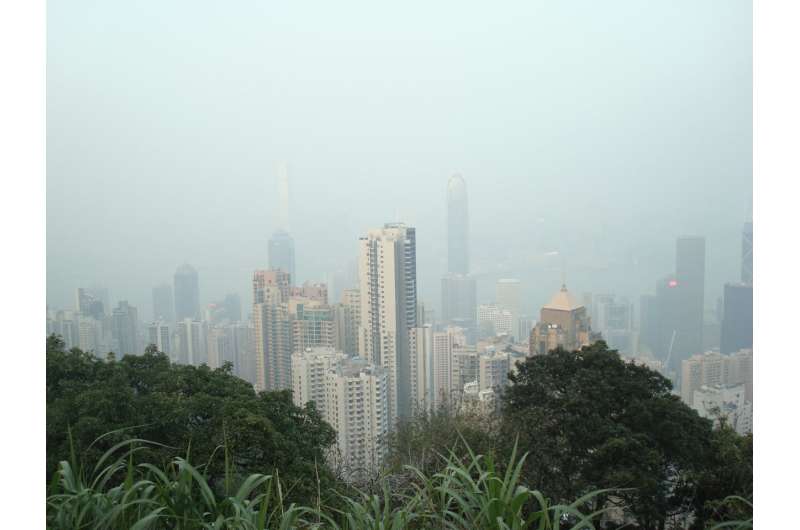
Medical and scientific evidence is proving invaluable in holding public authorities accountable for the impact of unlawful air pollution on people’s health, say experts in The BMJ‘s climate issue.
Gaia Lisi and Rupert Stuart-Smith at the University of Oxford say that relatively few studies attributing health impacts to climate change have been published so far, but as this research field matures, methods are becoming more widely recognized, opening up new routes for climate accountability.
They describe recent cases where medical and scientific evidence has been used to defend human rights to health.
For example, in the UK, the inquest into the death of 9-year-old Ella Adoo-Kissi-Debrah concluded that exposure to high levels of air pollution contributed materially to her death, while in a case against Italy, the European Court of Human Rights used peer-reviewed research to establish a “real and imminent risk” to life.
Similarly, in a series of civil liability cases in France, medical evidence was used to prove causal links between short-term peaks in air pollution and aggravation of respiratory symptoms in children.
And they say scientific evidence demonstrating the human health consequences of climate change is likely to assume greater importance in lawsuits in national, regional, and international forums following recent advisory opinions on climate change by the Inter-American Court of Human Rights and International Court of Justice saying that states have specific duties to protect the health of individuals from life threatening effects of climate change.
In lawsuits concerning environmental pollution, they also point out that medical experts have had a key role in helping courts understand the protections needed to uphold health-related laws, be it through conducting research underpinning legal arguments and judicial decisions, acting as expert witnesses, or providing third party evidence.
“Improved understanding of the health consequences of climate change could have a similar effect, clarifying the extent to which states are meeting their legal obligations to protect health, and opening up routes for climate justice where they fall short,” they conclude.
In a linked article, Laura Clarke at ClientEarth and Hugh Montgomery at University College London, say these landmark court decisions mean that big emitters, both states and companies, can no longer feign ignorance about the impacts of their activities.
“As attribution science strengthens further, we expect to see more class actions and damages claims brought by climate-affected communities which, when they scale, will change the calculations and business models of big emitters,” they add.
They suggest that health professionals can help in characterizing and appropriately attributing cause of deaths and disease resulting from the direct and indirect impacts of climate change, such as the direct health consequences of heat waves on kidney and heart disease, or reproductive health.
However, attribution to socioeconomic impacts will require the development of new models, they note.
Medical professionals can also drive action by helping to support legal interventions where those responsible for high greenhouse gas emissions are willfully indifferent or unresponsive, they add.
“If we are to make progress on emissions, action will require holding big polluters to account through the courts. Medical professionals, everywhere, should play their part in this process,” they conclude.
More information:
Medical evidence drove legal action to clean up the air we breathe—climate justice may be next, The BMJ (2025). DOI: 10.1136/bmj.r1568
Laura Clarke et al, Big emitters must be held responsible for deaths caused by climate change, BMJ (2025). DOI: 10.1136/bmj.r2246 , www.bmj.com/lookup/doi/10.1136/bmj.r2246
The content is provided for information purposes only.