

By the end of the year, the carbon footprint of global AI systems for the whole of 2025 could equal that of New York City. At the same time, AI’s thirst for water could rival that of the world’s bottled water market, according to new estimates.
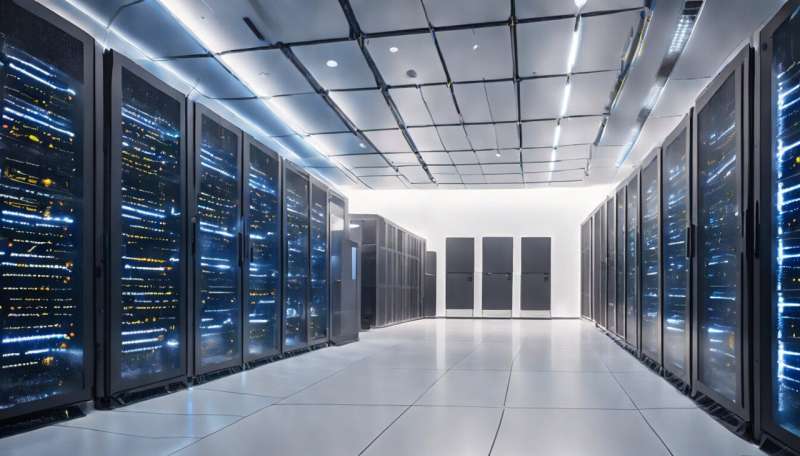
AI is everywhere and expanding at what seems like an exponential rate. The more we use it, the more data centers are needed to run the complex calculations that power AI. These facilities are not only huge guzzlers of electricity, but also of water, which is needed to cool servers and to generate electricity in power plants.
But exactly how much electricity and water they use is something of a mystery because accurate data is hard to come by. When big tech companies like Google, Amazon and Meta release their energy data, they lump it all together, making it impossible to see the potential environmental cost of AI. Some companies even refuse to report the water used by power plants, claiming it is out of their control.
In a paper published in the journal Patterns, Alex de Vries-Gao, a Ph.D. candidate at the VU Amsterdam Institute for Environmental Studies, put some numbers on AI’s environmental costs by using public corporate reports and International Energy Agency (IEA) data.
Calculating the hidden cost
First, de Vries-Gao estimated the total annual electricity consumption of AI hardware by combining data from multiple sources, including sales records and the power requirements of high-performance chips such as those from NVIDIA Corporation (the principal manufacturer of AI chips). For water consumption data, he looked at the efficiency with which data centers convert water into cooling and how much water power plants use to generate a kilowatt of power.
Then, with all that information, he was able to forecast the total carbon output and the amount of water used: “The carbon footprint of AI systems alone could be between 32.6 and 79.7 million tons of CO2 emissions in 2025, while the water footprint could reach 312.5–764.6 billion L,” he writes.
Call for action
In publishing these estimates, de Vries-Gao is trying to fill gaps in our knowledge because we don’t know how much energy and water artificial intelligence consumes. More data centers are going to be built to meet our ever-growing demand for AI, but without an accurate picture of the data, governments and regulators will remain in the dark about its true environmental cost.
“Further disclosures from data center operators are urgently required to improve the accuracy of these estimates and to responsibly manage the growing environmental impact of AI systems,” de Vries-Gao notes.
Written for you by our author Paul Arnold, edited by Lisa Lock, —this article is the result of careful human work. We rely on readers like you to keep independent science journalism alive.
If this reporting matters to you,
please consider a donation (especially monthly).
You’ll get an ad-free account as a thank-you.
More information:
Alex de Vries-Gao, The carbon and water footprints of data centers and what this could mean for artificial intelligence, Patterns (2025). DOI: 10.1016/j.patter.2025.101430
© 2025 Science X Network
The content is provided for information purposes only.