

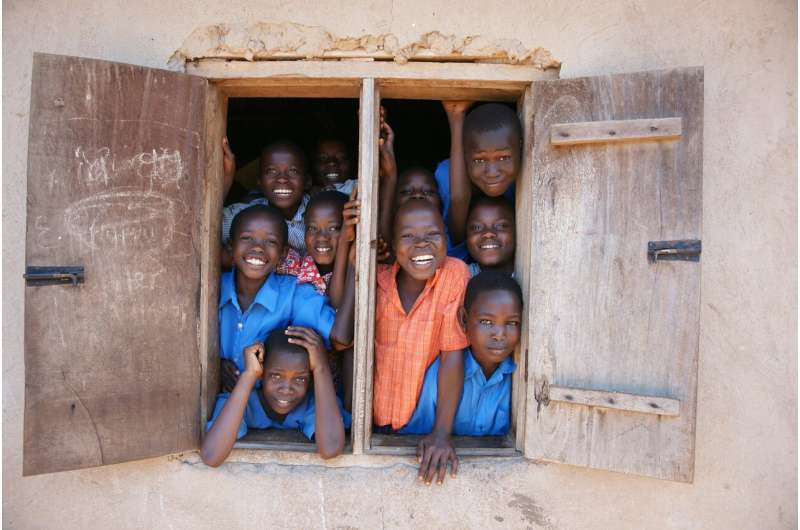
The scale-up of HIV treatment and prevention programs has led to remarkable declines in orphanhood rates in Rakai, Uganda, according to a new study at Columbia University Mailman School of Public Health. Antiretroviral therapy (ART) availability has been the primary driver of these improvements, underscoring the critical importance of sustained investment in HIV programs.
Findings from the study, “Incidence and prevalence of orphanhood in Rakai, Uganda: a population-based cohort study, 1995–2022,” are published in The Lancet Global Health.
Using data from the Rakai Community Cohort Study (RCCS), one of the largest community cohort studies in sub-Saharan Africa, the research tracked 92,441 children and adolescents under age 18 years in 28 continuously surveyed communities from 1995 to 2022 to advance understanding of orphanhood trends in the context of evolving HIV programs.
Between 2003–2004 and 2020–2022, orphanhood prevalence in Rakai declined dramatically from 21.5% to just 6.3%—a reduction of approximately 70%. Orphanhood incidence (new cases of becoming an orphan) showed an even greater decline.
The steepest declines occurred after ART became fully available (2015–22), compared to periods of partial availability (2004–14) and the pre-ART era (1995–2003). The proportion of new orphanhood cases attributed to maternal HIV status plummeted from 67% in 2004 to just 11% in 2022. For parental HIV status, attribution declined from 71% to 12% over the same period.
“The scale-up of antiretroviral therapy in Uganda has clearly played a leading role in the observed declines in orphanhood incidence, demonstrating the life-saving impact of comprehensive HIV treatment programs and treatment as prevention,” said Aleya Khalifa, Ph.D., postdoctoral research scientist in the Department of Population and Family Health, and co-lead author.
“Importantly, these programs have not just extended the lives of parents living with HIV but have also protected children from the devastating social and health consequences of losing their parents,” added Debbie Malden, DPhil and epidemiologist in the Columbia Population Research Center, and a co-lead author.
These findings provide compelling evidence for the effectiveness of widespread ART availability and the power of treatment as prevention in reducing orphanhood in sub-Saharan Africa, according to the authors. However, they emphasize that despite these gains, a considerable burden of orphanhood persists, particularly among adolescents.
The study recommends that public health policies should ensure sustained investment in HIV treatment and prevention programs, improve accessibility of ART services, and adapt programming to address the ongoing vulnerability of children at risk of orphanhood.
Publication details
Incidence and prevalence of orphanhood in Rakai, Uganda: a population-based cohort study, 1995–2022, The Lancet Global Health (2026).
Journal information:
The Lancet Global Health
Key medical concepts
The content is provided for information purposes only.