
- When slugs are threatened they release a sticky mucus to fix them in place
- An adhesive was developed from analysis of Arion subfuscus, a common slug
- Experts used it to repair a hole in a pig heart that was slick with blood
- Tests revealed it is significantly stronger than other medical adhesives
- It is also non-toxic and does not cause tissue damage or adhesions
Tim Collins For Mailonline
and
Colin Fernandez Science Correspondent For The Daily Mail
10
View
comments
It could give a new meaning to the phrase feeling sluggish.
Doctors may soon be patching up cuts and wounds in your body with a glue inspired by slug slime.
As any gardener who has observed the revolting pests scaling a wet flowerpot will know, the sticky mucus exuded by the revolting pests has the power to stick to wet surfaces.
This is a significant improvement on most glues invented by humans, which require nice dry surfaces to stick, or are often too toxic to use on a human wound.
Scroll down for video
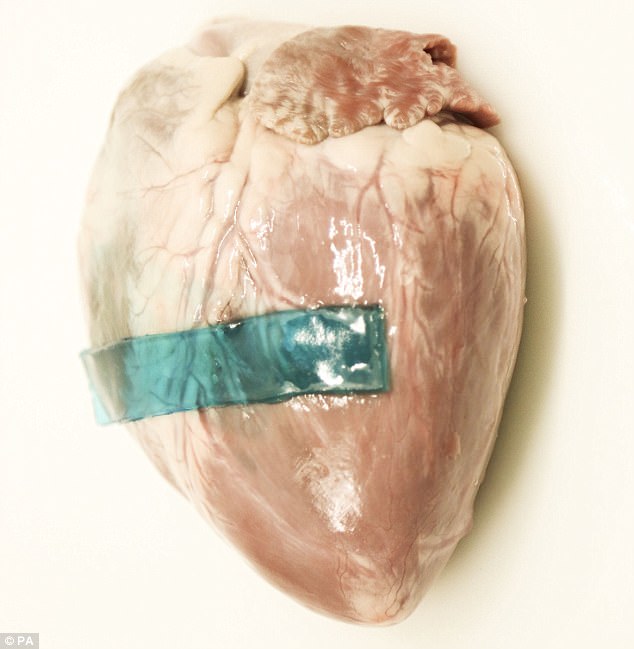
Slugs may not seem like the most hygienic inspiration for a medical breakthrough, but scientists have developed a new surgical glue based on their secretions. The wonder material could soon be used to seal wounds to soft and moist areas of the body, like the heart (pictured)
SLUG INSPIRED GLUE
The super-strong ‘tough adhesive’ is biocompatible and binds to tissues with a strength comparable to the body’s own resilient cartilage, even when they’re wet.
Tests revealed it bound together skin, cartilage, heart, artery, and liver with significantly greater strength than other medical adhesives.
There was also no tissue damage or adhesions to surrounding tissues when applied to a liver haemorrhage in mice.
These side effects that were observed with both super glue and a commercial thrombin-based adhesive.
Previous studies found the unique glue of the Dusky Arion (Arion subfuscus), common in Europe and parts of the US was composed of a tough matrix peppered with positively charged proteins
This inspired the scientists to create a double-layered hydrogel consisting of an alginate-polyacrylamide matrix supporting an adhesive layer that has positively-charged polymers protruding from its surface.
It binds to biological tissues by lectrostatic attraction to negatively charged cell surfaces, covalent bonds between neighbouring atoms, and physical interpenetration, making the adhesive extremely strong.
The bio-glue was developed by experts at the Wyss Institute for Biologically Inspired Engineering at Harvard University.
Jianyu Li and colleagues crates a ‘tough adhesive’ modelled on the defensive mucus secreted by Arion subfuscus, a common slug which ranges from orange to brown and is commonly found in Britain and western Europe.
The researchers say that in laboratory tests they successfully repaired a hole in a pig heart that was slick with blood.
The sealant did not leak when the pig’s heart beat, highlighting how the glue was flexible enough to cope with stretching.
The authors said that in experiments in rats simulating emergency surgery and sudden blood loss, the glue’s performance was similar to that of a haemostat.
This is a tool that looks a bit like a pair of scissors but which is used to clamp shut wounds during surgical procedures to stop bleeding.
Professor Donald Ingber, who worked on the project, said: ‘Nature has frequently already found elegant solutions to common problems.
‘It’s a matter of knowing where to look and recognising a good idea when you see one
‘We are excited to see how this technology, inspired by a humble slug, might develop into a new technology for surgical repair and wound healing.’
The ‘tough adhesive’ is biocompatible and binds to tissues with a strength comparable to the body’s own resilient cartilage, even when they’re wet.
Tests revealed it bound together skin, cartilage, heart, artery, and liver with significantly greater strength than other medical adhesives.
-
 ‘Insidious and sick’ Fruitfly malware has been spying on Mac…
 A glimpse into the afterlife? From speeding thoughts to…
 Newly-found species of winged dinosaur looked like a…
 First human embryos are edited in the US in a controversial…
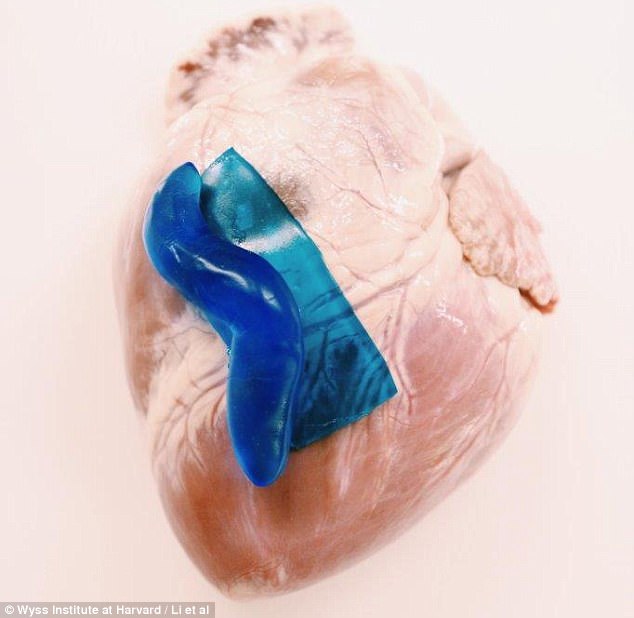
When slugs are threatened they release a sticky mucus to fix them in place, making it difficult for a predator to pry it off a surface. The adhesive developed (pictured) from analysis of this material is flexible, strong and non-toxic
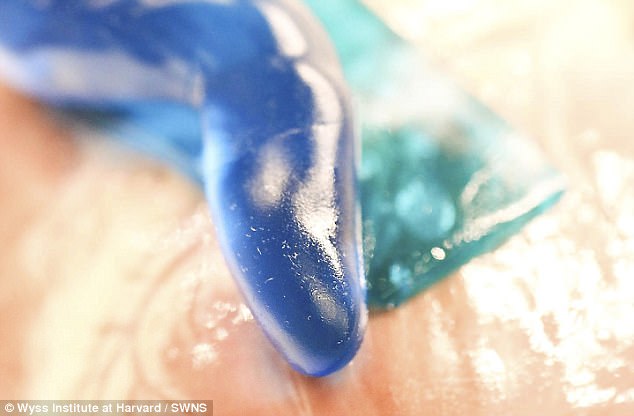
The bio-glue (pictured) was developed by experts at the Wyss Institute for Biologically Inspired Engineering at Harvard University
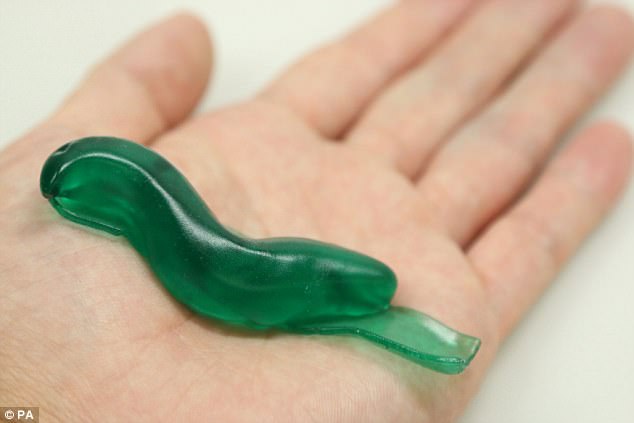
Jianyu Li and colleagues developed a ‘tough adhesive’ modelled on the defensive mucus secreted by Arion subfuscus, a common slug which ranges from orange to brown and is commonly found in Britain and western Europe (pictured)
There was also no tissue damage or adhesions to surrounding tissues when applied to a liver haemorrhage in mice.
These side effects that were observed with both super glue and a commercial thrombin-based adhesive.
Professor Dave Mooney added: ‘The key feature of our material is the combination of a very strong adhesive force and the ability to transfer and dissipate stress, which have historically not been integrated into a single adhesive.’
The high-performance material could be used as a patch that can be cut to desired sizes and applied to tissue surfaces or as an injectable solution for deeper injuries.
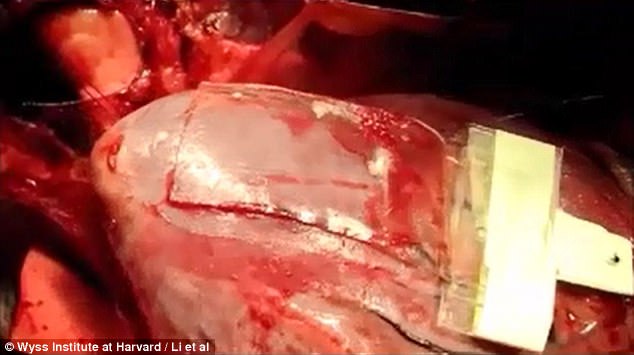
The researchers say that in laboratory tests they successfully repaired a hole in a pig heart that was slick with blood (pictured). The sealant did not leak when the pig’s heart beat, highlighting how the glue was flexible enough to cope with stretching
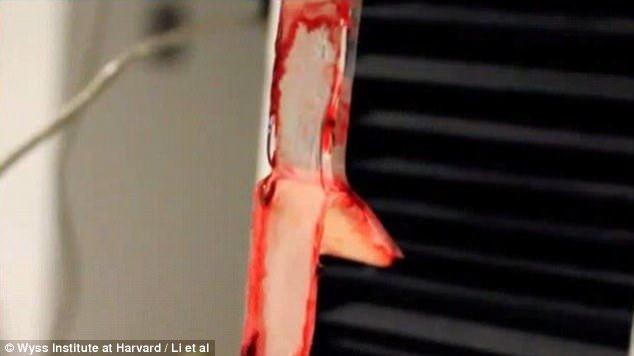
The super-strong ‘tough adhesive’ is biocompatible and binds to tissues (pictured) with a strength comparable to the body’s own resilient cartilage, even when they’re wet
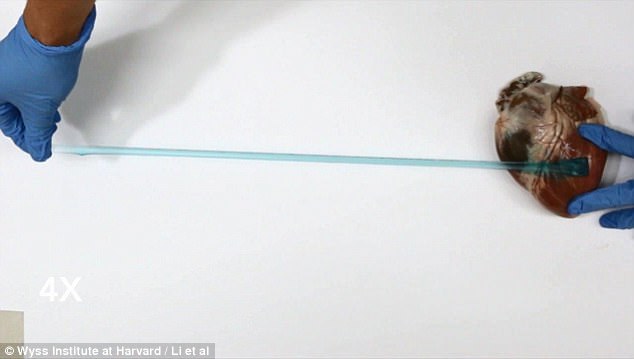
Tests revealed it bound together skin, cartilage, heart, artery, and liver with significantly greater strength than other medical adhesives (pictured)
It can also be used to attach medical devices to their target structures, such as an actuator to support heart function.
Previous studies found the unique glue of the Dusky Arion (Arion subfuscus), common in Europe and parts of the US was composed of a tough matrix peppered with positively charged proteins
This inspired the scientists to create a double-layered hydrogel consisting of an alginate-polyacrylamide matrix supporting an adhesive layer that has positively-charged polymers protruding from its surface.
It binds to biological tissues by lectrostatic attraction to negatively charged cell surfaces, covalent bonds between neighbouring atoms, and physical interpenetration, making the adhesive extremely strong.
The full findings of the study were published in the journal Science.
Share or comment on this article
-
 Epic moment a fearless young elephant bull chases off a…
 -
 Solved, the riddle of starlings’ aerial ballet: Birds use…
 -
 ‘Sponge Bob showed me’: Boy, five, brushes his EYES with…
 -
 Knifeman who killed a man, 50, in a rampage at a Hamburg…
 -
 Salt and vinegaaaah! Scientists create crisps made from…
 -
 Will robots DESTROY us? As the founders of Facebook and…
 -
 Woman who claims she was duped into assassinating Kim…
 -
 Model metamorphosis: Men and women transform their bodies…
 -
 Drink driver is brought to justice by 12-year-old cycling…
 -
 Two people killed and dozens injured in a stampede before…
 -
 BBC accused of having ‘something to hide’ after refusing…
 -
 The unsung heroes of Dunkirk: From the VC winner to the…
 -
 More than one million air passengers are missing out on…
 -
 Dear experts, you’ve got the wrong dinosaur! Boy, 10,…
 -
 Female BBC stars could claim MILLIONS of pounds of…
 -
 Top Gear host Chris Harris is left with an horrific head…
 -
 Millions of households should get a cash refund on their…
 -
 Venezuelan protestors strip National Guardsmen naked and…


Comments 10
Share what you think
-
Newest -
Oldest -
Best rated -
Worst rated
The comments below have not been moderated.
The views expressed in the contents above are those of our users and do not necessarily reflect the views of MailOnline.
Close
Your comment will be posted to MailOnline as usual.
Close
Your comment will be posted to MailOnline as usual
We will automatically post your comment and a link to the news story to your Facebook timeline at the same time it is posted on MailOnline. To do this we will link your MailOnline account with your Facebook account. We’ll ask you to confirm this for your first post to Facebook.
You can choose on each post whether you would like it to be posted to Facebook. Your details from Facebook will be used to provide you with tailored content, marketing and ads in line with our Privacy Policy.