
- Dr Mary Hayes, based in Chicago, says some treats are ‘less worse’ than others
- Depends on how much sugar they contain and how easily they wash off teeth
- She also shares tips for when children eat sweets to prevent tooth problems
Claudia Tanner For Mailonline
2
View
comments
The haul of sweet treats dished during trick-or-treating is regarded as a dentistry fright fest.
And while they know they should be thinking of their children’s teeth, few parents would say no to candy on Halloween – at least not without a mutiny on their hands.
So it’s worth knowing that some sugary treats are ‘less worse’ than others, according to a pediatric dentist.
Dr Mary Hayes, based in Chicago, reveals the process of decay peaks within 20 minutes of eating a sugary snack and the results linger there for hours after. This can lead to cavities.
Which treats are better depends on how much sugar they contain and how easily they wash off the tooth’s surface.
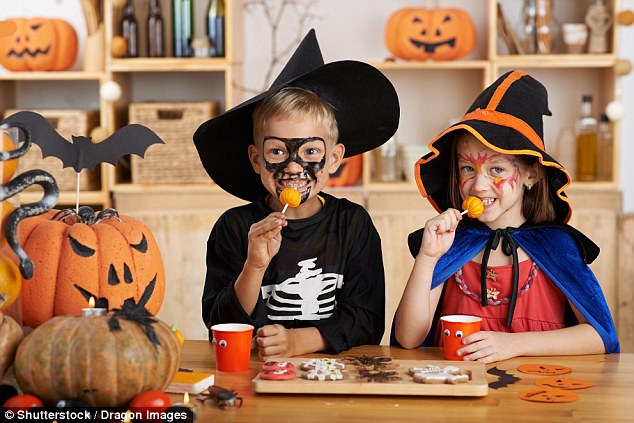
A Chicago-based pediatric dentist has revealed the best and worst sugary treats to give children at Halloween
-
 The girl who can SMELL colours: 11-year-old possesses the…
 The two-year-old girl paralysed by painful arthritis: Mother…
 Beware of Halloween contact lenses: Opticians warn novelty…
 Hundreds of women are dying needlessly each year because the…
Dr Hayes, who is an American Dental Association (ADA) spokesperson, revealed chocolate is the best to give to youngsters – which should be welcome news to many kids across the country.
She says it washes off teeth easier than other types of candy.
Furthermore, chocolate also contains oils that actually decrease the activity of the bacteria that cause decay, she told TODAY.
And most of us already know that dark chocolate is a healthier option because there’s less sugar in it – that’s if your little darling can take to it.
The expert also shared the sweets handed out on October 31 that are the worst for children’s oral health:
THE WORST HALLOWEEN SWEET TREATS FOR YOUR CHILD’S TEETH
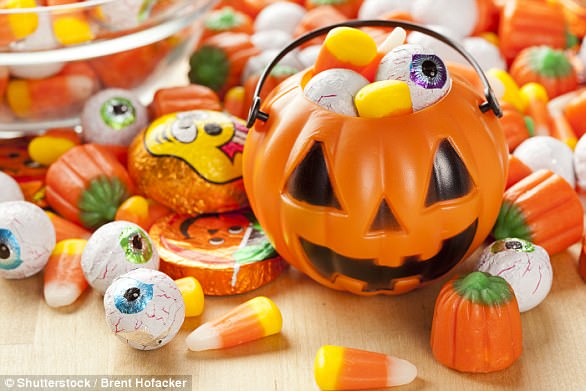
Dr Hayes has urged parents to avoid giving their children ‘pure sugar’ treats
Hard candy: It’s pure sugar and children tend to keep it in their mouths for a longer period of time, the ADA says. Additionally, you can break your teeth if you try to crunch an undissolved piece.
Gummy candy: The soft gel-like texture means it clings to teeth, which means there’s a higher risk of tooth decay.
Caramel: It’s extremely tasty but also sticky and harder to remove, creating a breeding ground for bacteria.
Sour candy: Sour means it’s very acidic, according to Dr Hayes. ‘In acid, the bacteria can work even more efficiently,’ she explained. ‘Acidic things that we eat change the pH of the mouth and… it’s a higher risk of decay.’
Tips to prevent tooth problems
Tooth decay in children is on the rise – and it’s entirely preventable. Recent headlines revealing tooth decay is a ‘leading cause of child hospital admissions’.
Dr Hayes advises to tell your children it’s OK to have a piece of candy or chocolate or a treat, as long as they know they need to brush it off their teeth.
She recommends parents follow the following advice:
Drink water after treats
This will wash away the acid and push around any food debris that’s left in your mouth. Encouraging your child to have more fluids brings general health benefits too.
Chew sugarless gum
When gum is chewed, this produces saliva which helps neutralize the acid in the mouth, explained Dr Hayes.
This can help older children but young ones are at risk of choking from chewing gum. Check with your doctor to see when your child is old enough to have some.
Inspect your child’s mouth
Dr Hayes urges parents to physically check their child’s mouth to see if there are bits of candy stuck on the teeth.
It’s important to directly supervise brushing for children under 6 because those who are younger often don’t do it thoroughly.
FOUR OUT OF FIVE TODDLERS NOT TAKEN TO DENTIST LAST YEAR
The vast majority of parents fail to take young children to the dentist regularly, official figures reveal.
Some 80 per cent of one and two-year-olds in England did not visit an NHS dentist last year, national statistics show.
The figure was 60 per cent for children aged one to four, according to data from NHS Digital.
This is despite the fact that NHS dental care for children is free.
Experts say the earlier a child sees a dentist, the earlier any potential problems can be spotted.
Official guidance states youngsters should start having regular dental check-ups as soon as their first teeth appear – usually at around six months – and continue with appointments once a year.
The Royal College of Surgeons, which collated the statistics, said there was ‘widespread misunderstanding’ among parents, and even health professionals, about when a baby should first visit the dentist.
Share or comment on this article
-
 Harry, Meghan and a VERY discreet tea party with the…
 -
 Is Melania Trump using a BODY DOUBLE? Conspiracy theory…
 -
 Putin can’t stop laughing when minister suggests Russia…
 -
 Horrifying moment heiress, 20, crashes into pedestrians…
 -
 ISIS fanatics ‘plotting new 9/11’: Homeland Security…
 -
 ‘I got a taste for men who are older’: Lana Del Rey…
 -
 Jenson Button reveals he confronted ‘out of order’…
 -
 ‘Revenge is sweet’: Jilted wife ‘texted her family in…
 -
 Traumatised IT worker, 31, who was beaten up in savage…
 -
 ‘I thought I was going to make it through this but I’m…
 -
 Man who sparked a massive manhunt is arrested in Delaware…
 -
 First sex doll-only brothel opens in Germany following…
 -
 Father pleads guilty to raping and murdering his…
 -
 How did Ellen blow it? Degeneres airs eight-minute…
 -
 Parents face 130 years in jail over sickening abuse of…
 -
 Students who ‘ran a drink-fuelled initiation at Newcastle…
 -
 Woman is rescued from gang-rape by TWENTY-FIVE local men…
 -
 White cop who shot dead his daughter’s mixed race…


Comments 1
Share what you think
-
Newest -
Oldest -
Best rated -
Worst rated
The comments below have not been moderated.
The views expressed in the contents above are those of our users and do not necessarily reflect the views of MailOnline.
Close
Do you want to automatically post your MailOnline comments to your Facebook Timeline?
Your comment will be posted to MailOnline as usual.
Close
Do you want to automatically post your MailOnline comments to your Facebook Timeline?
Your comment will be posted to MailOnline as usual
We will automatically post your comment and a link to the news story to your Facebook timeline at the same time it is posted on MailOnline. To do this we will link your MailOnline account with your Facebook account. We’ll ask you to confirm this for your first post to Facebook.
You can choose on each post whether you would like it to be posted to Facebook. Your details from Facebook will be used to provide you with tailored content, marketing and ads in line with our Privacy Policy.