
- The painkiller is available in corner shops, supermarkets and petrol stations
- Swiss researchers found it had a more profound effect than similar medications
- The scientists warned the results are worrying for the arthritis-prone elderly
Stephen Matthews For Mailonline
126
View
comments
Arthritis sufferers are at greater risk of heart disease and stroke if they take ibuprofen to dampen their pain, a study shows.
The common painkiller, available in corner shops, supermarkets and petrol stations, had a more profound effect on raising blood pressure than other similar medications.
The findings, made by Swiss researchers, adds to a growing body of evidence that suggests the cheap pills may have deadly consequences.
Scientists warned the results of the trial is worrying for the elderly, considering their higher rates of arthritis and hypertension.
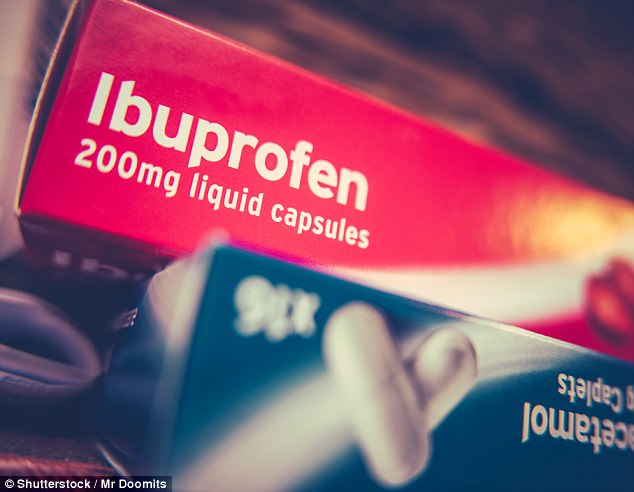
The findings, made by Swiss researchers, adds to a growing body of evidence that suggests the cheap pills may have deadly consequences
Frank Ruschitzka, professor of cardiology and head of the department at University Heart Centre, Zurich, was behind the study of arthritis patients who often rely on ibuprofen.
A ‘clear demonstration’
He said: ‘The study clearly demonstrates that non-steroidal anti-inflammatory drugs (NSAIDs), particularly ibuprofen, may be not as safe as previously thought.
‘Patients receiving ibuprofen had a 61 per cent higher incidence of hypertension compared to those receiving celecoxib.’
-
 New way to kill cancer is better than chemotherapy:…
 Why wearing a virtual reality headset may help to beat back…
 Middle age isn’t too late to get fit: You can halve the…
 My mother’s new hip has started shedding metal into her…
The findings, based on 444 patients, were presented at the European Society of Cardiology congress in Barcelona.
How was the study carried out?
All participants involved in the latest trial of three NSAIDs had evidence of or were at an increased risk of heart disease.
Investigators discovered that celecoxib, often sold under the brand name Celebrex, decreased systolic blood pressure slightly over a four-month period.
THE TRUE DANGERS OF IBUPROFEN
Ibuprofen and other painkillers may trigger a heart condition, a major study uncovered last September.
University of Milano-Bicocca in Italy experts found patients who regularly take the pills are up to 20 per cent more likely to develop heart failure.
While the over-the-counter painkillers taken by millions could significantly raise the risk of fatal heart problems, a major study suggested in March.
People who take ibuprofen have a 31 per cent increased risk of cardiac arrest, Copenhagen University Hospital scientists found.
Until recently, NSAIDs were used for arthritis and back pain – but several recent studies have suggested they could do more harm than good.
However, both naproxen and ibuprofen were found to increase it, raising the risk of heart disease and stroke. Ibuprofen’s jump was deemed significant.
What could the results lead to?
Professor Ruschitzka said decreasing blood pressure by a small amount could lower both stroke and heart mortality by 10 per cent and 7 per cent respectively.
He hypothesised that such an action could avoid more than 70,000 deaths from stroke and 60,000 deaths from coronary heart disease each year.
Welcomed by experts
Arthritis Research UK said ibuprofen, one of the most widely prescribed drugs in the world, was taken by many sufferers.
A spokesman said: ‘Long-term use of NSAIDs, including ibuprofen, can increase the risk of problems with your heart or circulation.’
They added: ‘You shouldn’t take ibuprofen for long-term pain relief without seeing your doctor first.’
Professor Jeremy Pearson, associate medical director at British Heart Foundation, welcomed the findings.
He said that patients and doctors must ‘weigh up the risk and benefits of NSAIDs’, especially if they have another long-term health condition.
Share or comment on this article
-
 The Palestinian cartoonist and a new clue in hunt for his…
 -
 Now the Bank of Mum and Dad pays the rent too: Parents…
 -
 Cruel teenage girl dumps a cat in a wheelie bin before…
 -
 ‘Neighbour from hell’ threatened to set fire to the…
 -
 Youngsters are rushed to hospital after falling victim to…
 -
 Big Six energy firms have made more than £7bn in just…
 -
 Daughter’s rage at burglar who punched and dragged her…
 -
 Tell me he’s locking the door these days! North Korea…
 -
 Battle of Waterloo: Cancellations and delays at Britain’s…
 -
 Brave mother-of-two reveals horrific injuries she…
 -
 Big SMACK and cries! Headbutts and chairs fly when mass…
 -
 Family of Christian girl, 5, forced into foster care with…
 -
 Britain will be more vulnerable to terrorists after…
 -
 Pictured: British family who were rescued ‘by pure luck’…
 -
 Pilot and five passengers are injured when plane makes…
 -
 Labour civil war over single market U-turn: MPs warn of…
 -
 Galloping with joy, the pony left for dead: Buggy is…
 -
 EU’s tantrum over Brexit divorce bill: Brussels orders…


Comments 126
Share what you think
-
Newest -
Oldest -
Best rated -
Worst rated
The comments below have not been moderated.
The views expressed in the contents above are those of our users and do not necessarily reflect the views of MailOnline.
Close
Your comment will be posted to MailOnline as usual.
Close
Your comment will be posted to MailOnline as usual
We will automatically post your comment and a link to the news story to your Facebook timeline at the same time it is posted on MailOnline. To do this we will link your MailOnline account with your Facebook account. We’ll ask you to confirm this for your first post to Facebook.
You can choose on each post whether you would like it to be posted to Facebook. Your details from Facebook will be used to provide you with tailored content, marketing and ads in line with our Privacy Policy.