

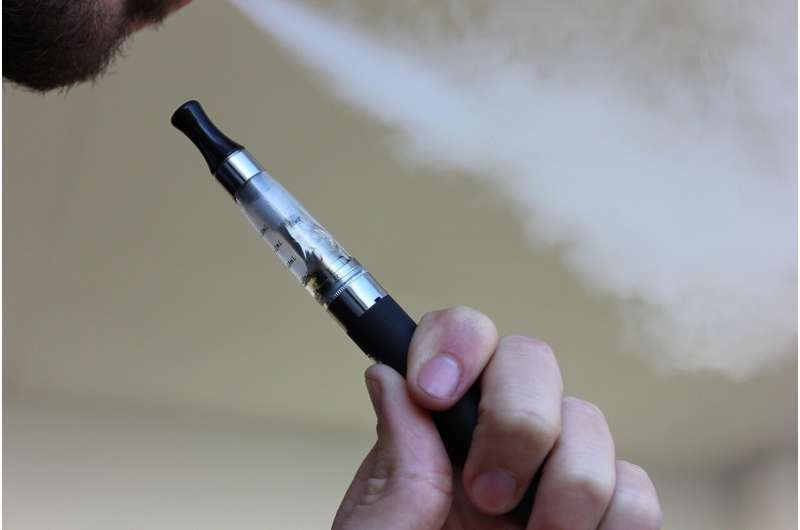
Smokers who quit with the help of e-cigarettes often continue vaping, but it is not known whether this promotes or prevents relapse back to smoking.
Led by Queen Mary University of London’s Professor Peter Hajek, this study in the journal Addiction, “Continuing use of e-cigarettes after stopping smoking and relapse: Secondary analysis of a large randomized control trial” provides the first evidence that smokers who successfully stop smoking with the help of vapes and continue to use them may be reducing their risk of relapse.
Only a relatively small proportion of smokers who quit with the help of nicotine replacement therapies (NRT) such as nicotine chewing gum and patches continue to use NRT. In contrast, smokers who quit with the help of e-cigarettes (EC) are much more likely to continue using vapes. This raises an important question of whether continuing use of vapes increases the risk of relapse back to smoking, in which case smokers should be advised against such use; or whether it provides a protection from relapse, in which case it would have a positive effect.
The team conducted a secondary analysis of their landmark randomized controlled trial that included 886 smokers and showed that EC are more effective in helping smokers quit than NRT. In this report, they compared relapse rates in the two study arms, and in abstainers who did, and did not use e-cigarettes. Relapse was calculated for the time periods between 4 weeks and 1 year, and between 6 months and 1 year.
Over both time periods, abstainers in the EC arm were less likely to relapse than abstainers in the NRT arm; and abstainers who used EC were less likely to relapse than abstainers who did not vape.
Professor Peter Hajek, director of the health and lifestyle research unit at Queen Mary University of London, said, “EC use carries only a small fraction of the risks of smoking. Among people who quit smoking with the help of vapes, on-going vaping prevents relapse. It would have a positive health impact and should not be discouraged.”
Hayden McRobbie, professor of population health at Queen Mary University of London, said, “A big question in helping people stay smokefree is how best to prevent relapse. For people who have quit smoking using EC, carrying on vaping for as long as they need to feel confident they won’t slip back to smoking is likely to be beneficial.”
Dr. Francesca Pesola, senior lecturer in statistics at Queen Mary University of London, said, “We now want further studies to see whether this finding holds over a longer period of time.”
The authors of this paper were academics from Queen Mary University of London (Peter Hajek, Dunja Przulj, Katie Myers Smith, Peter Sasieni, Hayden McRobbie) Francesca Pesola, University of York (Jinshuo Li) the National Centre for Smoking Cessation and Training in Leicester (Louise Ross), the National Drug and Alcohol Research Centre, University of New South Wales (Hayden McRobbie), and Roswell Park Comprehensive Cancer Center (Maciej Goniewicz).
Publication details
Continuing use of e-cigarettes after stopping smoking and relapse: Secondary analysis of a large randomised control trial, Addiction (2026). DOI: 10.1111/add.70294
Journal information:
Addiction
The content is provided for information purposes only.