

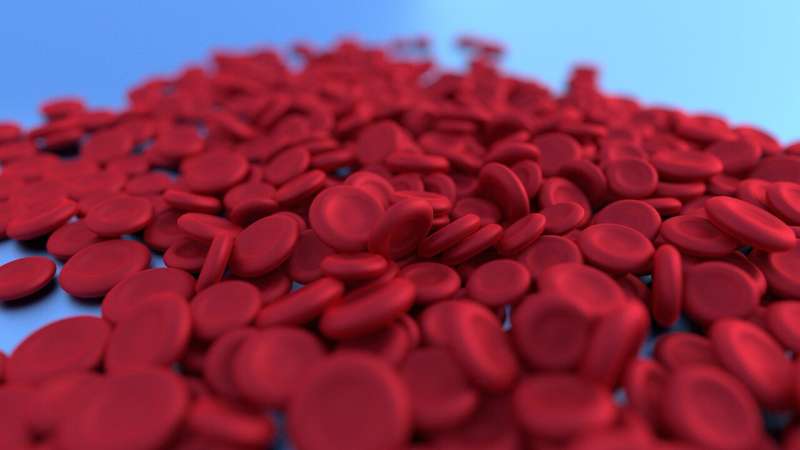
Northwestern Medicine scientists have discovered that the hormone FGF23 reduces the production of red blood cells and may contribute to the development of anemia in chronic kidney disease, according to a recent study published in Blood.
Valentin David, Ph.D., MSc, the Frank Krumlovsky, MD, Professor of Medicine in the Division of Nephrology and Hypertension, was senior author of the study.
Fibroblast growth factor 23 (FGF23) is a phosphate-regulating hormone produced by osteocytes, the most common cell found in mature bone. FGF23 is also produced by erythroid cells—which are derived from hematopoietic stem and progenitor cells.
Increased levels of circulating FGF23 have been shown to be associated with impaired erythropoiesis, or the process by which red blood cells are produced, in response to iron deficiency anemia and chronic kidney disease. However, how FGF23 produced by osteocytes and erythroid cells contribute to iron deficiency anemia has remained poorly understood.
In the current study, David’s team engineered mice with a conditional deletion of FGF23 in either osteocytes or erythroid cells. The mice were then given either a normal diet or an iron-deficient diet.
In mice fed an iron-deficient diet, the scientists found that both osteocytes and erythroid cells contributed to circulating intact FGF23 (iFGF23) and FGF23 cleaved peptides (broken-down fragments of proteins).
In the iron-deficient mice, they also found that deletion of FGF23 in erythroid cells corrected anemia. Furthermore, deleting furin—an enzyme that promotes FGF23 cleavage—in erythroid cells led to increased production of iFGF23 from erythroid cells and induced anemia.
“When iron availability is limited, such as in iron deficiency anemia or anemia of chronic kidney disease, this hormone acts as a brake and stops the erythroid progenitors from consuming all the available iron only to differentiate into poorly functional mature erythroid cells,” David said.
The investigators also found that deletion of FGF23 in erythroid cells in animal models of chronic kidney disease prevented the development of anemia.
“This natural hormone acts as a paracrine factor to limit erythropoiesis when iron is not sufficiently available,” David said.
The findings suggest that FGF23 expressed in erythroid cells negatively regulates erythropoiesis and, when it becomes maladaptive, may contribute to the development of anemia of chronic kidney disease. Targeting cells that produce FGF23 in response to different signals, David said, could therefore be a promising therapeutic approach.
“I think part of the problem is that FGF23 in chronic kidney disease triggers so many negative effects, but its presence still mitigates hyperphosphatemia; increased FGF23 prevents circulating phosphate levels from becoming excessively high. That’s part of the problem: we need to reduce it but not eliminate it. I think we are slowly but surely driving towards finding mechanisms to actually target specific isoforms and cells that produce FGF23 in chronic kidney disease and other conditions,” David said.
Publication details
Guillaume Courbon et al, Erythroid-produced intact FGF23 is a paracrine inhibitor of erythropoiesis, Blood Journal (2026). DOI: 10.1182/blood.2025030634
Journal information:
Blood
Key medical concepts
Clinical categories
The content is provided for information purposes only.