

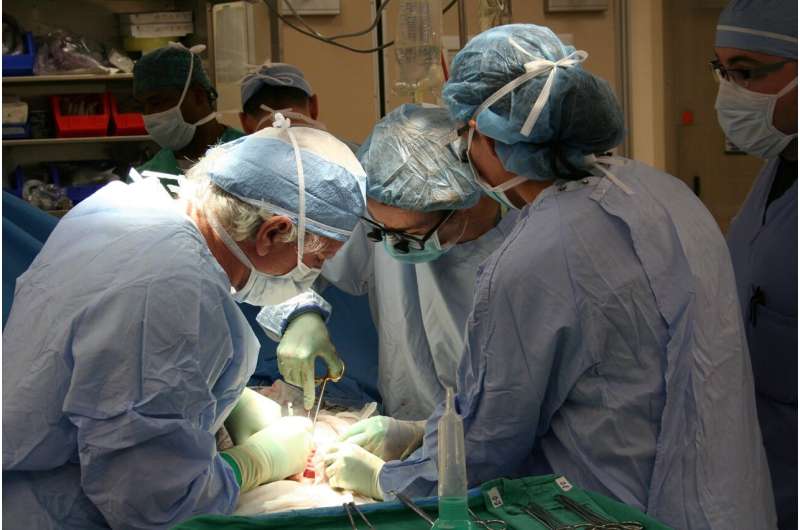
A pioneering clinical trial has successfully enabled two patients with end-stage kidney disease to receive previously improbable kidney transplants. These individuals were considered among the most difficult in the nation to match with a compatible donor kidney due to harmful antibodies they had developed (“sensitized”).
Researchers at the University of Pennsylvania (Penn) used chimeric antigen receptor (CAR) T-cell therapy, originally developed at Penn for treatment of blood cancer, to significantly reduce the level of harmful immune antibodies in these two highly sensitized patients, making kidney transplantation possible after years of waiting. The study’s findings appear in the New England Journal of Medicine.
“This is the first demonstration that CAR T cells can be used not only to treat cancer, but also to help patients who previously had no opportunity to receive a compatible donor kidney,” said Ali Naji, MD, Ph.D., the Jonathan E. Rhoads Professor of Surgery and principal investigator of the study. “For patients who have spent years on the kidney transplant waiting list, this approach could be transformative.”
A critical challenge in kidney transplantation
More than 91,000 Americans are currently waiting for a kidney transplant. Among them, roughly 5,000 are “highly sensitized,” meaning their immune systems harbor extremely high levels of antibodies that would attack most donor kidneys. These antibodies are measured using a score called a Calculated Panel Reactive Antibody, or cPRA.
Patients with a cPRA of 99.9% or higher are compatible with fewer than one in 1,000 donor kidneys and often must wait years for a suitable organ. In many cases, patients with extremely high cPRA scores never find a match. Traditional methods, such as a plasma exchange or drugs that try to block harmful antibodies, often fail in the most sensitized patients.
Repurposing CAR T therapy for transplant access
This Phase I clinical trial (NCT06056102)—a collaboration between researchers from Penn Medicine, NYU Langone, and Mass General—is the first to test whether dual CAR T-cell therapy, a treatment developed at Penn Medicine by Dr. Carl June and approved by the FDA in 2017 for treatment of blood cancers that reprograms a patient’s own immune cells, can safely remove the specific immune cells responsible for making anti-donor antibodies.
The experimental approach combines two engineered T-cell therapies; CD19-targeted CAR T-cells, which eliminate memory B cells, and BCMA-targeted CAR T cells, which deplete antibody-producing plasma cells. By removing both cell types, researchers aimed to markedly reduce circulating antibodies and effectively “reset” the immune system, enabling highly sensitized patients to receive donor kidneys that were previously incompatible.
Two Penn Medicine patients with cPRA levels near 100%, each having spent years on transplant waitlists without a single viable match, underwent this CAR T-based desensitization. Both experienced dramatic reductions in the harmful immune antibodies that typically attack donor kidneys, and their cPRA scores lowered enough to make new donor matches possible.
As a result, both patients successfully received kidney transplants. To date, neither has shown signs of donor-specific antibody rebound or organ rejection.
Minimal toxicity observed in early trial
“In this early trial, the CAR T-cell treatment was tolerated well, with no severe side effects, and the immune system began to recover as expected,” said study co-author Robert Montgomery, MD, Ph.D., the H. Leon Pachter, MD, Professor of Surgery, chair of the Department of Surgery at NYU Grossman School of Medicine, director of the NYU Langone Transplant Institute.
“This early success reflects what’s possible when teams across institutions push the boundaries of what cell therapy can do for transplant medicine. This treatment opens up new options for patients and could save thousands more lives every year.”
Notably, neither patient developed severe cytokine release syndrome or neurotoxicity, two complications that are sometimes observed in cancer patients treated with CAR T-cell therapies. The depletion of immune cells was temporary, as healthy B-cell populations gradually recovered over time.
Future phases of the trial will study higher doses of CAR T cells and enroll a larger group of patients to further assess safety, durability, and overall effectiveness.
“The success of this trial underscores the extraordinary caliber of science at Penn and the power of cross-disciplinary collaboration, exemplified by the contributions of Mary Kaminski, PA-C and Kyle Jackson MD, Ph.D., from Penn Transplant Surgery, Vijay Bhoj, MD, Malek Kamoun MD, Ph.D., and Nicholas Brown Ph.D. from Penn Pathology, Sabiha Hussain, MD of Penn Nephrology, and Alfred Garfall, MD from Penn Hematology and Oncology,” said Naji.
“We are grateful for the leadership and advice of our colleagues at the National Institute of Allergy and Infectious Diseases (NIAID) in the implementation of this multicenter novel therapy to facilitate successful kidney transplantation.”
Publication details
New England Journal of Medicine (2026).
Journal information:
New England Journal of Medicine
The content is provided for information purposes only.