

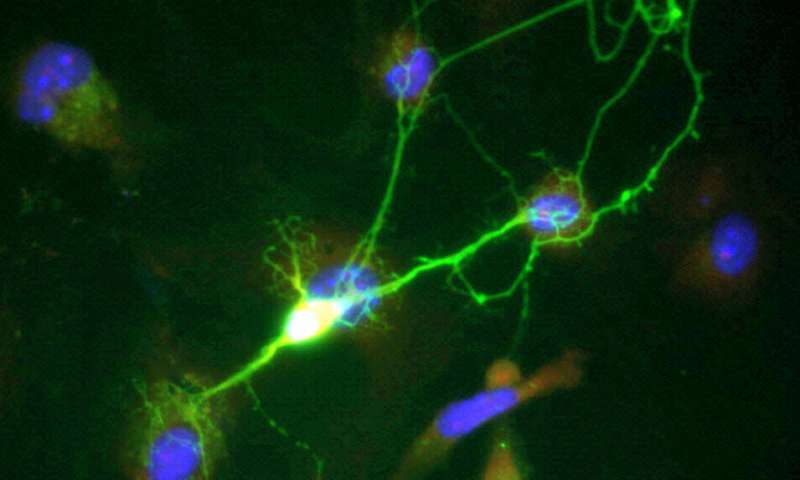
An important chemical messenger that typically inhibits brain activity might sometimes do the opposite, according to new Yale School of Medicine (YSM) research. One way that brain cells communicate is through chemical messengers called neurotransmitters. Most research indicates that the neurotransmitter GABA (gamma-aminobutyric acid) quiets brain signals, serving as the system’s brakes.
Now, a new study published in Neuron suggests that this story might not be so simple. Yale researchers have found that GABA can, under certain circumstances, enhance neuronal activity.
Promoting GABA signaling is a common target for the treatment of anxiety and other psychiatric conditions. Scientists have long assumed that these therapies work by dampening overactive brain circuits. Now, this research suggests that “there may be more going on,” says Michael Higley, MD, Ph.D., professor of neuroscience at YSM.
The work is a reminder that “the most unexpected results, the ones that are really surprising, are very often those worth following,” he says.
Certain GABA signals can boost calcium influx
The nervous system uses electrical signals to tell our bodies what to do. Whether a neuron broadcasts a signal—helping to move an arm, store a memory, or learn a new skill—is controlled by neurotransmitters.
Neurons release GABA and other neurotransmitters into the tiny spaces called synapses that separate them. The neurotransmitters then bind to receptors on the receiving neuron, increasing or decreasing the likelihood that the neuron will fire.
While decades of research have shown that GABA largely inhibits neuronal firing, a handful of recent studies suggest that GABA might sometimes do just the opposite.
How this happens, however, is unclear.
A few years ago, Higley and his colleagues were running an experiment when they noticed some strange results. The researchers blocked GABA from being received in brain tissue, which would normally mean neurons would show increased activity. But instead, the team saw a “surprising and robust decrease in signals corresponding to activity,” says Higley.
In the new study, the researchers used an imaging technique called two-photon microscopy to track the concentration of calcium ions in mouse neurons. A brief influx of calcium into the cell typically indicates that it has fired, or activated, in response to input.
Several earlier studies, including from the Higley lab, found that GABA could suppress these calcium signals, as expected for a classic inhibitor.
Surprisingly, in this new study, when the researchers blocked GABA transmission in both brain slices and in living mice, they observed a decrease in calcium influx—suggesting that neurons had become less active, rather than more.
The team also found that not all GABA receptors were involved. Only GABA-alpha-5 receptors—one of 19 identified types of GABA-alpha receptors—acted in this unusual way.
A new perspective on GABA in health and disease
Computer models created by the researchers suggest that GABA is still acting as expected for the most part, quieting neuronal activity. But for alpha-5 receptors, inhibiting electrical activity comes with an unexpected side effect: It makes neurons more likely to suck in calcium ions the next time the cell decides to fire.
The team then showed that this “paradoxical effect” could enhance calcium-dependent neural plasticity, which is one way that the brain learns and develops memories, says Higley.
GABA-based therapies are used to treat many psychiatric and neural conditions, including schizophrenia, depression, and epilepsy. For some of these conditions, the secondary effect on neural plasticity—which can help people develop new habits and attitudes—might help explain why these therapies work. Targeting this pathway could even provide new avenues for developing therapies, says Higley.
Overall, this research doesn’t undermine researchers’ understanding of GABA and how it inhibits brain function, he says. “But it does add an interesting and unexpected spin to it,” says Higley. “And it could open up totally new perspectives on the role of GABA signaling in health and disease.”
Publication details
Chiayu Q. Chiu et al, SST interneurons facilitate dendritic calcium signaling via tonic activation of ?5-GABA receptors, Neuron (2026). DOI: 10.1016/j.neuron.2026.04.017
Journal information:
Neuron
Key medical concepts
The content is provided for information purposes only.