

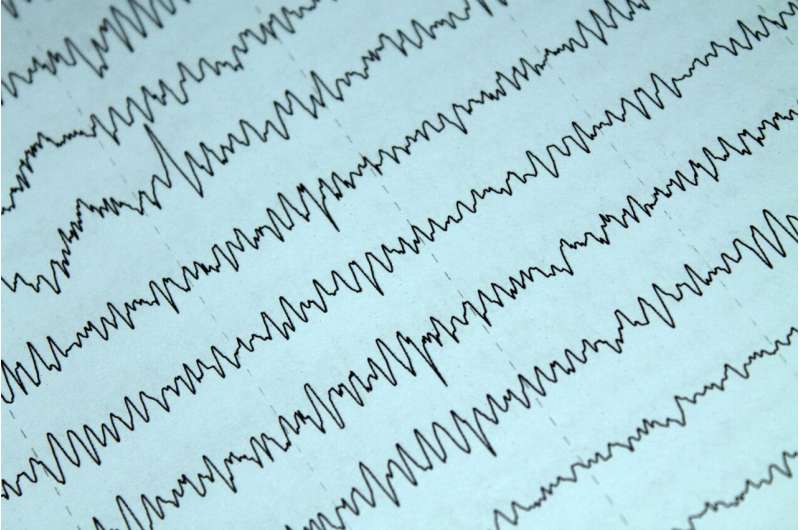
Working with concurrent electroencephalogram and functional magnetic resonance imaging technology at the Beckman Institute’s Biomedical Imaging Center, postdoctoral researcher Suhnyoung Jun and her colleagues have investigated how the brain connectome’s dynamics unfold across different timescales, captured by these two technologies at the same time. The team’s paper is published in the journal Proceedings of the National Academy of Sciences.
Jun has always been interested in brains. She is the co-first author of the paper, which centers on the connectome, the comprehensive neural network within the brain. She works in the CONNECTlab with psychology professor Sepideh Sadaghiani.
In her previous research, Jun focused on heritable features, or traits passed from parents to children through DNA, centering on how patterns of communication within the connectome change over time. For this research, she used either fMRI or EEG data. At the time, she was analyzing each modality separately.
One brain, several streams
fMRI captures brain activity indirectly through changes in blood oxygenation at slow timescales, while EEG measures electrophysiological signals at much faster timescales. For years, many people assumed both modalities were capturing the same underlying brain activity at different speeds, with fMRI simply a slowed-down version of the EEG signal.
Jun and her colleagues challenged this assumption in their recent publication. By recording EEG-fMRI data at the same time, they found that the brain isn’t running a single process. Instead, it runs many distinct coordinated processes at the same time. These separate yet parallel streams have their own character and unfold independently of each other.
“It’s like when we process language,” she said. “The brain tracks the rapid flicker of individual sounds, the slower arrival of words and the still slower thread of meaning all at once, each on its own stream.”
Five years to clean data
Access to the Beckman Institute’s facilities was invaluable in conducting this research, Jun said, adding that the research couldn’t have been conducted anywhere else.
“Recording both modalities at the same time was the only way to answer this kind of question,” she said.
Still, the research process was long, spanning almost five years from conception to publication. The team of researchers from the CONNECTlab spent time completing safety training and experimenting, which led to a separate publication on that topic. In addition, identifying and cleaning artifacts from concurrently recorded EEG and fMRI data took years. Thanks to the staff at the Biomedical Imaging Center, they eventually found a way to record clean data.
Sadaghiani contacted previous collaborators to use a set of concurrent EEG-fMRI data from Paris, and Jun established a relationship with the Minnesota Center for Twin and Family Research to work with a large EEG dataset of 443 participants. Both datasets provided additional validation for the findings.
Clinical gaps EEG could fill
With all these resources and collaborators in place, the team’s results were clear.
“There are multiple streams going on there, but they can talk to each other,” Jun said. “What’s striking is that these separate streams are built from the same spatial blueprints, and they tend to play out in the same order, but asynchronously.”
The paper sheds light on the complexity of the brain and its processes and definitively shows that fMRI and EEG capture different information. Jun hopes the impact will go beyond the scientific community. For example, the paper illustrates the usefulness of EEG technology, possibly paving the way for more clinical use in circumstances where patients can’t have MRI scans, either because of the expense or the limitations of MRI technology.
“We are losing all their data,” Jun said, “and the MRI-based story that’s going out into the world won’t represent that population.”
This work has the potential to advance research on neurological and psychiatric conditions, including neurodegenerative diseases such as dementia and autoimmune diseases like HIV.
“I hope that my research will help more patients,” Jun said, “and that it will be used by someone who is near to translational work.”
Publication details
Thomas H. Alderson et al, Shared spatial and temporal principles govern connectome dynamics across timescales, Proceedings of the National Academy of Sciences (2026). DOI: 10.1073/pnas.2535464123
Journal information:
Proceedings of the National Academy of Sciences
Key medical concepts
Clinical categories
This content is provided for information purposes only.