

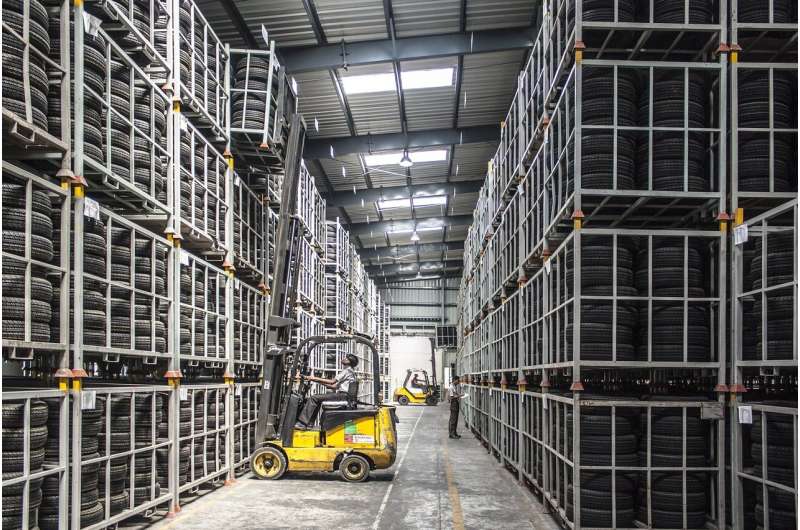
In an e-commerce warehouse, worker performance is influenced by the performance of those around them, despite a system that discourages interaction, according to research from Caitlin Ray, ILR assistant professor in the Human Resource Studies Department.
“If you’re placed in a group of people who perform higher on average, your performance is going to be higher,” said Ray. “If it’s a lower-performing group, then your performance tends to be lower.”
These findings have implications for grouping workers more efficiently and suggest that workers are not as interchangeable as warehouse designers may have assumed.
In an e-commerce warehouse Ray recently studied, employees were expected to work independently and complete tasks within a tight schedule, ranging from as little as 20 seconds to as much as three minutes, depending on the specific task. With only a short time allowed per task, employee interaction is considered a time-wasting distraction.
Ray, first author of “How Newcomers and Incumbents Adapt Their Daily Performance to Others in Jobs Where Social Interaction Is Unnecessary,” studied how workers influence one another under these circumstances. The findings are published in the Journal of Applied Psychology.
For the research, Ray was provided with warehouse worker data covering 31 months from 2015 to 2017. During that span, the warehouse fulfilled approximately 8,000 orders per day and employed over 1,000 people. “They were able to provide us with every single second of performance data. That’s a really unique feature of the data,” Ray said.
Based on four studies of the data, a key recommendation was to group newcomers, when possible, with high-performing incumbents. “In these settings, it is helpful to surround newcomers with consistent high performers to get their performance levels as high as possible as quickly as you can,” Ray said.
Ray hopes to do another study into e-commerce warehouse turnover rates. “Many companies in this industry seem hyper focused on individual outputs instead of what could be done collectively … there’s so much literature on the emergence of workplace culture and climate and the power of identifying and fostering the things that make us want to go to work,” Ray said.
Publication details
Caitlin Ray et al, How newcomers and incumbents adapt their daily performance to others in jobs where social interaction is unnecessary., Journal of Applied Psychology (2026). DOI: 10.1037/apl0001314
Provided by
Cornell University
The content is provided for information purposes only.