

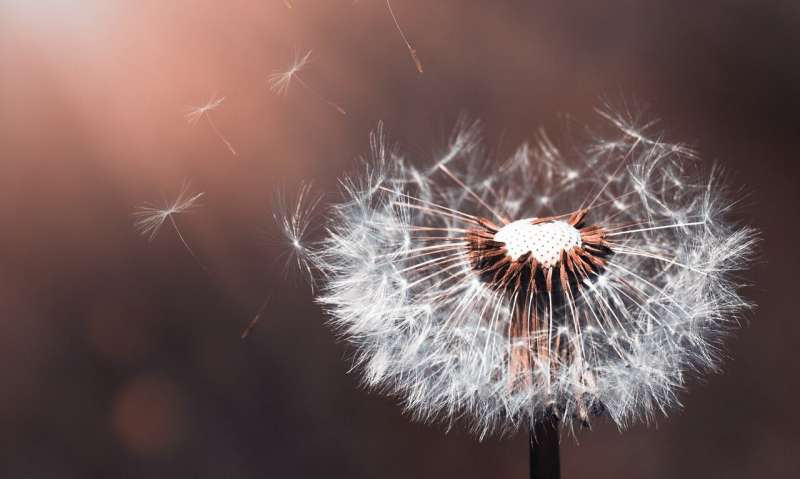
Dandelions are incredible plants with a highly efficient seed-dispersal system, meaning even a gentle breeze can carry seeds and their parachutes great distances. But in several places in Aichi Prefecture, Japan, they have changed, and the seeds now are more likely to stay much closer to home, according to a study published in the journal Biology Letters.
Researchers from Naruto University of Education and Aichi University of Education wanted to know whether plants living in isolated city sites, such as shrines and parks, are evolving to have reduced seed dispersal so they don’t land on surfaces where they can’t grow or survive.
This was a way to see whether Darwin’s wind hypothesis (the idea that organisms on islands evolve so they don’t get blown into the sea, such as insects losing their wings) applied to cities. Instead of being surrounded by water, green spaces and historical sites are surrounded by the concrete jungle.
Shrinking parachutes
The team compared seed dispersal traits of dandelions at Nagoya Castle and Atsuta Shrine with those of dandelions from open rural areas. They measured things like the pappus (white fluff or parachutes) and the achene (seed). While the seeds were roughly the same size, the city dandelions had smaller, less fluffy pappi.
To see if this difference changed how seeds moved, the scientists performed a drop test. They released the seeds in a controlled chamber with still air to see how long it took them to reach the ground. The rural seeds stayed airborne for longer, meaning they could be carried further by a breeze. The city seeds, however, dropped to the ground much faster. In other words, they are likely to stay near where they started their flight.
Next, the researchers conducted a genetic analysis on both sets of seeds and found that city dandelions had a much lower genetic diversity than those from rural areas, which could be a response to long-term isolation. However, they can’t rule out environmental effects and emphasize the need for future experiments, such as growing plants from different sites under identical conditions. This could confirm a genetic basis for the observed traits.
Urban conservation
While any adaptations may help protect the city’s dandelions, they could also be their undoing in the long run. Because the seeds are not traveling very far, they are becoming evolutionary islands, cut off from the genetic diversity of other dandelions. According to the researchers, this is something we should bear in mind to protect city nature.
“Our findings illustrate how extreme habitat isolation within cities can shape dispersal evolution and emphasize the importance of incorporating evolutionary processes into the conservation of plant populations in these environments.”
Written for you by our author Paul Arnold, edited by Sadie Harley, —this article is the result of careful human work. We rely on readers like you to keep independent science journalism alive.
If this reporting matters to you,
please consider a donation (especially monthly).
You’ll get an ad-free account as a thank-you.
Publication details
Kazuki Tagawa et al, Reduced seed dispersal potential in dandelions isolated within urban historical sites, Biology Letters (2026). DOI: 10.1098/rsbl.2025.0518
The content is provided for information purposes only.