

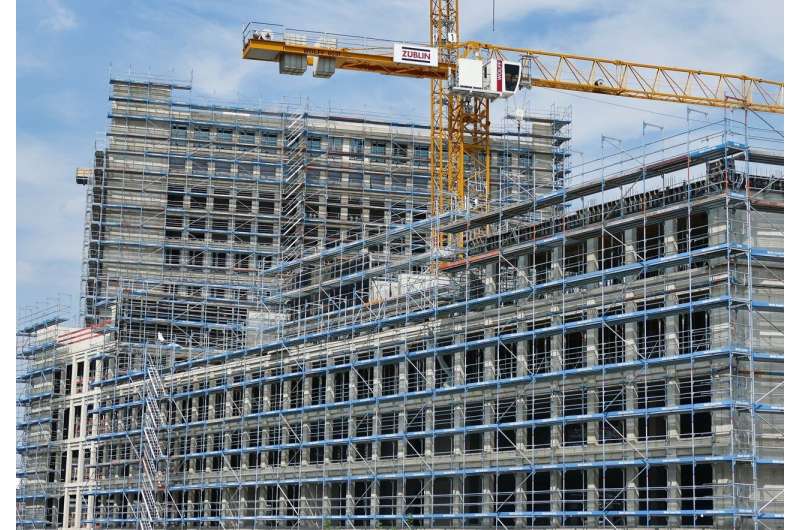
Many cities are making great strides in the fight against climate change, such as improving building energy efficiency, reducing traffic congestion and switching to renewable power sources. But there is another often overlooked problem, and that is the environmental impact of construction.
A new study published in the journal Nature Cities, covering more than 1,000 cities worldwide, reports that construction emissions are much higher than previously thought. On average, they account for 10–20% of global greenhouse gas emissions.
The researchers found that construction emissions in cities are currently around one to three metric tons of greenhouse gas per person, per year. One surprising discovery was that 60% of the emissions come from smaller cities with fewer than 500,000 people.
At current rates, they estimate that construction alone could consume all or most of the emissions allowed to keep global warming under 2°C. This is the limit countries agreed to in the Paris Agreement to prevent the planet from heating too much.
Building the future
The study authors didn’t only highlight the problem; they also came up with a series of proposals that they believe could help keep construction emissions low enough over the next few decades to stay within climate limits. And these solutions don’t necessarily involve cutting down on construction or building less. Instead, they focus on using better materials and smarter designs.

The principal suggestions were to move away from concrete and steel and use engineered wood (a low-carbon alternative), while also being smarter about how we use space. That means building more multi-unit apartments instead of larger single-family suburban homes. In cities where construction demand is very high, the study suggests a trade-off. For example, they may need to decarbonize sectors like transport and energy more quickly to free up enough of the carbon budget for building.
New tools to track emissions
“Cities must take a leading role in building a future within climate limits,” the research team noted in their paper. To make this happen, they have launched an open-access dashboard so urban planners, officials, politicians, and citizens can see how much their city is emitting. This could help them develop science-based solutions to fix the problem.

“Our findings…can help city-level stakeholders create science-backed plans for meeting future construction demand within climate targets.”
By following ideas like those presented in the paper, cities could stay within climate targets even if they continue with extensive building programs.
Written for you by our author Paul Arnold, edited by Gaby Clark, —this article is the result of careful human work. We rely on readers like you to keep independent science journalism alive.
If this reporting matters to you,
please consider a donation (especially monthly).
You’ll get an ad-free account as a thank-you.
Publication details
Keagan Hudson Rankin et al, The climate limits of construction in over 1,000 cities, Nature Cities (2026). DOI: 10.1038/s44284-025-00379-8
The content is provided for information purposes only.