

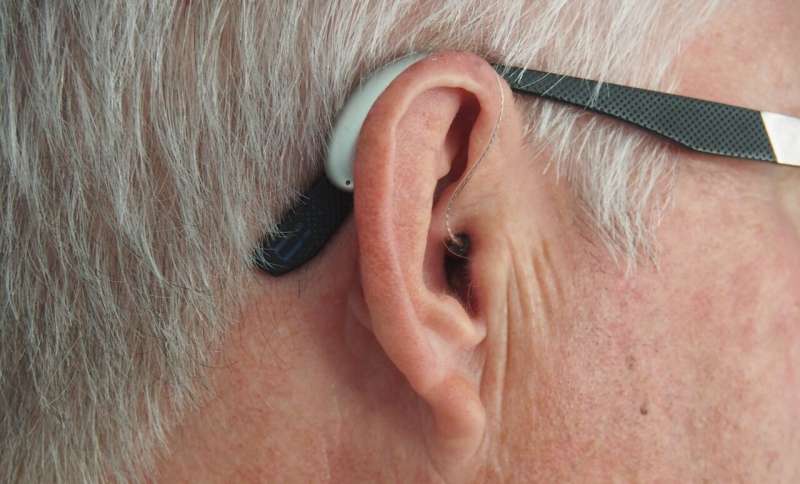
Artificial intelligence-powered glasses developed by a University of Stirling researcher could dramatically improve how people with hearing loss experience sound.
It aims to help by filtering out background noise in real time, even in loud environments, through the use of AI-powered smart glasses.
The device uses a small camera built into glasses to track the speaker’s lip movements, while a smartphone app uses 5G to send both audio and visual data to a powerful cloud server.
There, artificial intelligence isolates the speaker’s voice from surrounding noise and sends the cleaned-up sound back to the listener’s hearing aid or headphones almost instantly.
This approach, known as audio-visual speech enhancement, takes advantage of the close link between lip movements and speech.
While some noise-canceling technologies already exist, they struggle with overlapping voices or complex background sounds – something this system aims to overcome.
The project, which builds on a 2015 Stirling-led study, has been led by Heriot-Watt University and involves Dr. Ahsan Adeel from the University of Stirling’s Faculty of Natural Sciences – working alongside researchers from the University of Edinburgh and Edinburgh Napier University.
Dr. Ahsan Adeel, Associate Professor in Artificial Intelligence at the University of Stirling’s Computing Science and Mathematics Division, who first coined the idea of 5G-IoT-enabled, multi-modal hearing aids in 2018, said, “It is highly gratifying to see that the next-generation hearing aid vision is now taking practical shape.
“We are grateful to our 5G Internet of Things colleagues at Heriot-Watt, Napier, and the University of Edinburgh for believing in this vision and helping make it a reality.”
Breakthrough
Dr. Adeel continued, “Looking ahead, to further overcome persistent challenges of delay, privacy, and cost, we are moving beyond current AI – built on the oversimplified, 20th-century conception of neurons – towards harnessing the extraordinary capabilities of pyramidal cells in the mammalian neocortex, the part of the brain in mammals that handles reasoning and decision making, regarded as a hallmark of conscious processing.
“This breakthrough approach shifts from abstract, human-level cognitive audio-visual models to true cellular-level multisensory processing, enabling the world’s first personalized, standalone, data center, cloud-independent, biologically plausible hearing aids – a feat beyond current AI and neuromorphic systems.
“These devices will match human-level performance while consuming less power than a dim light bulb, delivering minimal latency, and ensuring complete privacy.
“This work is deepening our understanding of the neurobiological foundations of multisensory audio-visual speech processing and accelerating the creation of next-generation, biologically inspired models and hearing aids. Ultimately enhancing hearing aid uptake and enabling better participation in challenging social settings.”
A new approach
More than 1.2 million adults in the UK have hearing loss severe enough to make ordinary conversation difficult, according to the Royal National Institute for Deaf People.
Hearing aids can help, but most are limited by size and processing power and often struggle in noisy places like cafés, transport hubs or workplaces.
By shifting the heavy processing work to cloud servers, the researchers can apply powerful deep-learning algorithms without overloading the small, wearable device.
The group is working on multiple fronts, from cloud AI to edge device AI, to achieve optimal results for sustainability.
From lab to life
Still in the prototype stage, the team has already tested the technology with people who use hearing aids. Early results are promising and the team are speaking to hearing aid manufacturers about future partnerships and hoping to reduce costs to make the devices more widely available.
The team has already hosted workshops for hearing aid users and continue to collect noise samples, from washing machines to traffic, to improve the system.
They believe the cloud-based model could one day be public, allowing anyone with a compatible device to connect and benefit.
Professor Mathini Sellathurai of Heriot Watt University, who leads the project, said, “We’re not trying to reinvent hearing aids. We’re trying to give them superpowers. You simply point the camera or look at the person you want to hear.
“Even if two people are talking at once, the AI uses visual cues to extract the voice of the person you’re looking at. There’s a slight delay, since the sound travels to Sweden and back, but with 5G, it’s fast enough to feel instant.
“One of the most exciting parts is how general the technology could be. Yes, it’s aimed to support people who use hearing aids and who have severe visual impairments, but it could help anyone working in noisy places, from oil rigs to hospital wards.
“There are only a few big companies that make hearing aids, and they have limited support in noisy environments. We want to break that barrier and help more people, especially children and older adults, access affordable, AI-driven hearing support.”
Citation:
AI glasses could be a improvement for those with hearing loss ( 13)
14
ai-glasses-loss.html
The content is provided for information purposes only.