

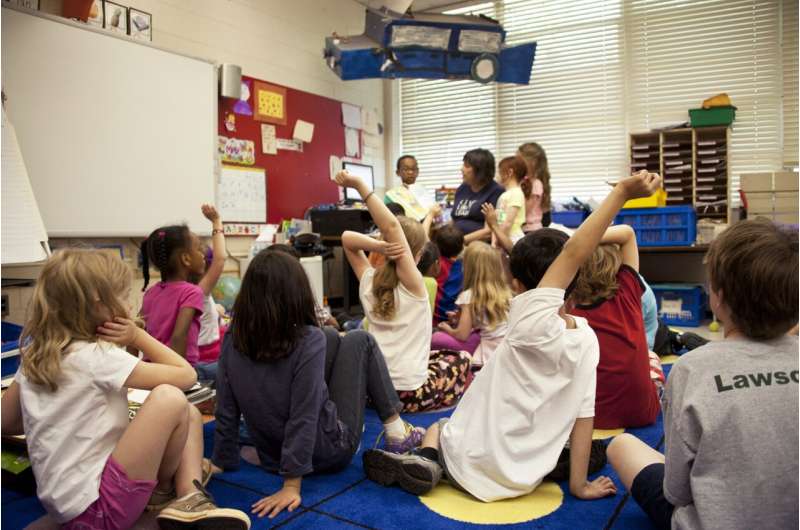
For Black boys living in the poorest neighborhoods, positive school experiences showed no significant effect on depressive symptoms, according to a Rutgers study.
Researchers have long known that when children feel supported by their teachers and peers, it is easier for them to develop skills to succeed in school and beyond.
But a new Rutgers study has found that the effects of positive support in the classroom are far from universal, and often, it’s Black boys from poorer neighborhoods who benefit the least.
“Boys perceive a positive school climate but don’t seem to benefit from it in the way girls do,” said Adrian Gale, an assistant professor in the Rutgers School of Social Work and the lead author of the study, published in the journal Developmental Psychology.
“If we can understand the mechanisms that drive this difference, then perhaps we can help boys attain better outcomes later in life,” Gale said.
In 2024, nearly 70% of female high school graduates ages 16 to 24 enrolled in college, compared with just over 55% of male high school graduates, according to data from the U.S. Bureau of Labor Statistics. By race and ethnicity, the college enrollment rate was highest for Asian graduates (94.7%), followed by white (62.2%), Black or African American (59.2%), and Hispanic or Latino (55.4%).
Gale said a key factor in whether students pursue post-secondary education is how supported they feel in primary and secondary school, a concept scholars refer to as “school climate.”
Educators have long studied how school climate affects student mental health and academic performance. Yet less is understood about how perception of school climate varies across sociodemographic and economic groups.
Indeed, most studies investigating the link between income and adolescents’ school climate perceptions have been conducted with white adolescents, Gale said, adding that researching school climate among Black adolescents is especially important because their experiences in classrooms and hallways often differ sharply from those of white students, shaping both their well-being and their academic paths.
To address this knowledge gap, Gale and Lenna Nepomnyaschy, a professor of child health and development at the Rutgers School of Social Work, examined associations between Black adolescents’ school climate perceptions and depression—and whether gender and family income mediate this association.
Using data from the Future of Families and Child Wellbeing Study, a multiyear study of children born in the United States between 1998 and 2000, the researchers examined responses from 1,883 Black 15-year-olds to questions about school climate and depressive symptoms. The sample included 950 boys and 933 girls.
As expected, female students across economic groups who reported a more positive view of their school had fewer depressive symptoms. But what surprised the researchers was that despite feeling well-supported at school, boys in the lowest economic group had the highest rate of depressive symptoms compared with girls and boys in wealthier areas.
In other words, those most vulnerable to poor mental health outcomes gained the least from a nurturing school environment.
While the researchers didn’t look specifically at academic performance, Gale said the findings suggest supportive school culture is failing to influence Black boys’ mental health and long-term education decisions in the same way it affects Black girls.
The precise cause of this gap isn’t clear, but Gale has a few guesses. For starters, many factors influence depression, such as home life and neighborhood conditions. Family income and gender are just two variables.
Most importantly, what girls need from teachers differs from boys. Gendered socialization patterns, which encourage girls to prioritize relationships and emotional support, make them more likely to benefit from positive school environments in their current form, Gale said.
Boys also may face societal expectations that discourage emotional expression and reliance on social support, limiting their ability to effectively engage, he said.
Going forward, Gale said he hopes the data will encourage educators and school leaders to be deliberate in how they entice young Black males to learn.
“We need to get to a point where teachers and administrators cultivate the idea that schools aren’t just places to educate but are also places to socialize and form a family of peers,” Gale said. “Helping boys feel connected to their school in this way can help them later in life.”
More information:
Adrian Gale et al, Perceptions of school climate and depression among Black youth: Do sex and income matter?, Developmental Psychology (2025). DOI: 10.1037/dev0002054
Provided by
Rutgers University
The content is provided for information purposes only.