

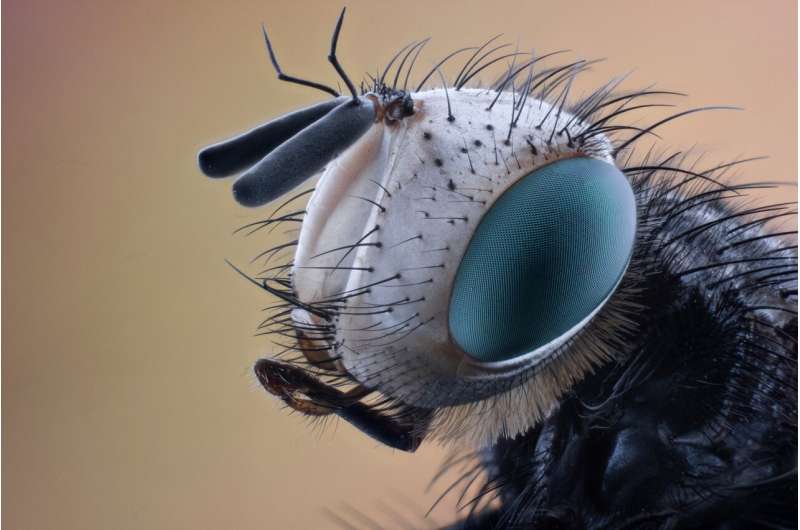
Jakob von Uexküll was a Baltic German biologist ahead of his time, intrigued by the idea that animals inhabit unique perceptual worlds quite unlike our own. In 1934, he described angling for flies by swinging an adhesive-covered pea on a thread, finding that male flies would dive on the pea and be caught. Within the perceptual world of a fly, the swinging pea was a potential mate.
We can’t be exactly sure what a fly’s perceptual world looks like, but we know it must be very different to our own. And learning about it can do much more than satisfy our curiosity. It could help keep people safe from disease.
While a human eye has only one lens, the main eyes of flies are compound eyes that each consist of hundreds or thousands of individual lenses. A fruit fly eye has about 700, and a blowfly eye 5,000. Each of these lenses is part of a sampling unit called an ommatidium, which also contains eight light-sensitive photoreceptor cells.
The structure of the compound eye affects a fly’s ability to make out shapes and patterns. In houseflies, light from a given point in its field of view activates seven photoreceptors in seven separate ommatidia through their respective lenses. Combined, that information is a bit like an image pixel.
Information about shape and pattern is generated when the visual system compares neighboring “pixels.” The arrangement of lenses in the compound eye limits the minimum size of a “pixel” and thus a fly’s ability to make out spatial details.
As a result, a fly can only resolve relatively coarse spatial detail. If a housefly and a human with 20/20 vision were taking an eyesight test, the fly would need to be about 6cm from the chart to make out the detail that the human could at six meters. For the fly to achieve human-like spatial resolution, it would need larger lenses and a flatter eye, resulting in a compound eye about one meter in diameter.
This lack of spatial acuity is compensated for with speed. Some fly species’ photoreceptors respond much faster than human photoreceptors. This is true of day-active flies which have faster-responding photoreceptors than their more ponderous, nocturnal kin. For us, a flashing light blurs into a constant one at 50–90 flashes per second, but a blowfly’s photoreceptors can distinguish more than 200 separate flashes per second. Thus, we perceive motion in the fast sequence of static images comprising a cartoon, but a fly might not be fooled.
Given this, it’s no wonder that swatting an irritating fly can be a challenge. When a scientist from Florida tried to photograph resting long-legged flies, he found that the flies were generally in flight, potentially startled by the flash, before the image was even captured.
Saying this, some fly eyes are specially adapted for both spatial and temporal detail. Male flies of many species have eyes that meet at the top and front of the head, while those of females have an obvious gap. The extra region of the male eye is the “love spot”, with larger lenses and faster-responding photoreceptors that give improved sensitivity to small and fast-moving objects needed for tracking females during high-speed airborne courtship chases.
Killer fly relatives of the humble housefly are also adapted for great visual prowess, here needed to catch small insect prey like fruit flies mid-flight.
Most people don’t consider perception as they try to shoo an annoying fly out of an open window, or whack it with a newspaper. However, understanding insect perception can inspire new ways of controlling pests, as von Uexküll’s fly “fishing rod” demonstrated. This is important because lots of flies transmit disease, so we need to control flies to prevent sickness in humans and animals.
Perception of color is important in this context. The human retina has three kinds of cone photoreceptors sensitive to blue, green and red light, and our brains compare those three signals to create color perceptions. By contrast, a typical housefly ommatidium has five types of photoreceptors including a couple sensitive to UV, but none that are particularly sensitive to red light.
As a result, color perceptions must be quite different for flies and humans, and experiments with blowflies suggest they perceive just four distinct colors, some with no human equivalent. Whether this is true of other flies remains to be seen.
In Africa, tsetse flies spread sleeping sickness, which has profound effects on the central nervous system that upset the sleep/wake cycle, cause confusion and sensory disturbances, and ultimately lead to death without treatment.
Colored fabric targets doused with insecticide are often used to control tsetse flies and protect humans and animals, and normally these targets are blue. However, we modeled fly color perception to develop a better color for luring flies, which turned out to be purple to a human eye. We recently found that this color attracts stable flies and houseflies as well, which are also vectors of human and animal disease.
In urban settings, we are combining color and spatial vision models to understand how to better manage flies in these environments. A particular challenge is that artificial lighting is designed for human vision, and lacks UV wavelengths that flies are sensitive to. This gives the light an entirely different color from their point of view, and potentially prevents flies from differentiating between colors that they otherwise would under natural lighting.
By delving into the fly’s perceptual world, we hope we can better understand their behavior, and devise new methods to control them.
This article is republished from The Conversation under a Creative Commons license. Read the original article.
The content is provided for information purposes only.