

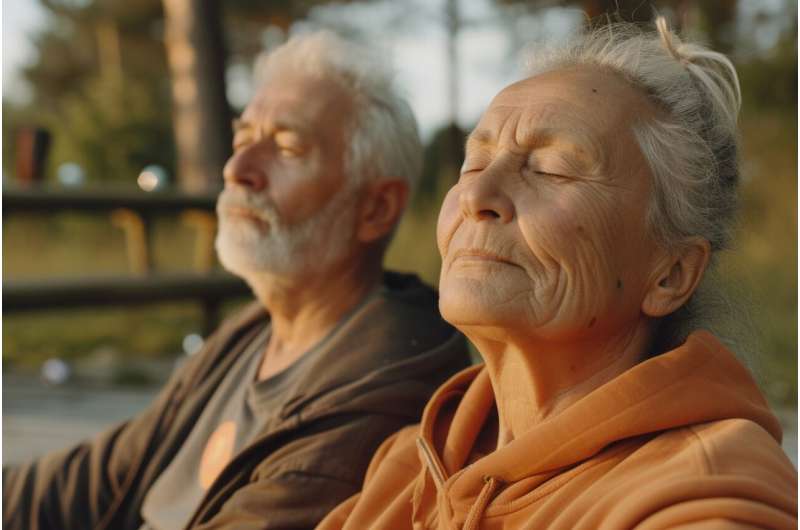
As people age, they display a bias in recognizing emotions as positive—to the point of improperly labeling neutral or negative emotions as positive.
Some researchers theorize this bias is an adaptive mechanism to support mental and emotional wellness, but new evidence suggests it may be a sign of cognitive decline.
In a JNeurosci paper, Noham Wolpe, from Tel Aviv University, and colleagues, from the University of Cambridge, advance understanding of what this positive emotional bias that elders exhibit signifies about their brains’ health.
A large pool of participants (665) viewed faces in an emotion recognition task. Age-related positivity bias correlated with poorer cognitive performance in two assessments, but not necessarily emotional decline as measured by examining nonclinical depressive symptoms.
The researchers also observed structural changes in brain areas associated with emotional processing and changes in how these areas communicate to another brain region involved in social decisions. Thus, positivity bias from aging impacts the brain in observable ways that could be leveraged clinically to detect early rising signs of age-related neurodegeneration and cognitive decline.
Says Wolpe of the group’s next steps, “We are exploring how these findings relate to older adults with early cognitive decline, particularly those showing signs of apathy, which is often another early sign of dementia.”
More information:
Age-Related Positivity Bias in Emotion Recognition is Linked to Lower Cognitive Performance and Altered Amygdala–Orbitofrontal Connectivity, JNeurosci (2025). DOI: 10.1523/JNEUROSCI.0386-25.2025
Citation:
Positive emotional bias could be an early sign of cognitive decline in aging populations ( 25)
29
positive-emotional-bias-early-cognitive.html
The content is provided for information purposes only.