

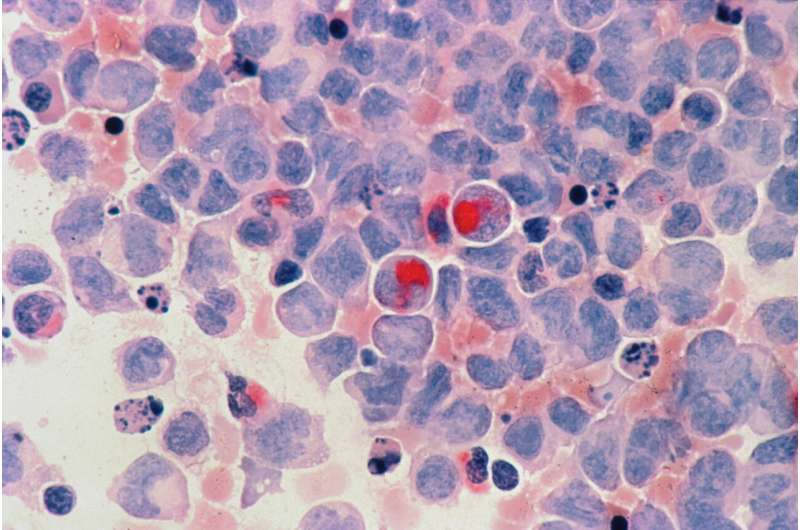
A Yale study published on the cover of the journal Blood explains basic scientific discoveries that could lead to innovative therapies for acute myeloid leukemia, and specifically a rare and aggressive blood cancer known as acute megakaryoblastic leukemia (AMKL).
The study identified the mechanism underlying the relationship between the development of AMKL and a specific genetic alteration that occurs primarily in children. This genetic alteration causes the formation of a mutant protein.
The researchers hypothesized that the mutant protein disrupts a process called m6A modification, which is involved in instructing the behavior of particular RNAs responsible for transmitting genetic information from DNA.
They discovered that the mutant protein can attach to and modify RNA, essentially hijacking normal m6A processes and changing how the RNA behaves.
“By using the expertise of multiple labs, we’ve been able to identify how the mutant protein RBM15-MKL1 interacts with RNA on a very deep level, and we’ve shown that these interactions are essential for how leukemia persists. This is a huge step forward in understanding this disease,” says doctoral student Madeline Mayday, a primary author on the study and a member of the Krause Lab at Yale Cancer Center.
The study found that the mutant protein selectively regulates Frizzled proteins, which are linked to activation of a known cancer pathway called Wnt signaling. Inhibition of Frizzled gene activity hampered the growth of AMKL in the lab and in animals, highlighting the role of Wnt signaling in this specific blood cancer.
“We looked at hundreds of patient samples across many types of leukemia and saw that AMKL caused by other genetic alterations also had upregulation of a Wnt pathway signature, suggesting that all forms of AMKL may have evolved with a common reliance on Wnt signaling and may thus be targetable with drugs that target the Wnt pathway,” says Diane Krause, MD, Ph.D., a senior author on the study and Anthony N. Brady Professor of Laboratory Medicine and professor of pathology at Yale School of Medicine.
The researchers also showed that an experimental inhibitor of the m6A process—a drug called STM3675 that has been used in preclinical studies—disrupts m6A modification, decreases pathways such as Wnt signaling, and kills leukemia cells in the lab and in mice.
“Our study highlights the importance of translational research. We developed AMKL preclinical models to investigate RNA binding and m6A alterations that are driven by a leukemogenic mutant protein, and we showed that these alterations can be corrected when using a small molecule inhibitor with demonstrated anti-cancer activity,” says Giulia Biancon, Ph.D., primary and co-corresponding author and a former member of the Halene Lab at Yale Cancer Center.
“This discovery provides further evidence of how alterations in RNA biology drive human diseases and demonstrates the power of big data analysis in uncovering these crucial mechanisms,” says Toma Tebaldi, Ph.D., a senior author on the study and an adjunct assistant professor of medicine (medical oncology and hematology).
Arthur H and Isabel Bunker Professor of Medicine (Hematology) and Professor of Pathology Stephanie Halene, MD, a senior author on the study, says that drugs targeting both the writer of the m6A modification and the WNT pathway are in clinical trials for cancer and could one day be available to treat this rare leukemia in children.
More information:
Madeline Y. Mayday et al, RBM15-MKL1 fusion protein promotes leukemia via m6A methylation and Wnt pathway activation, Blood (2025). DOI: 10.1182/blood.2024027712
The content is provided for information purposes only.