

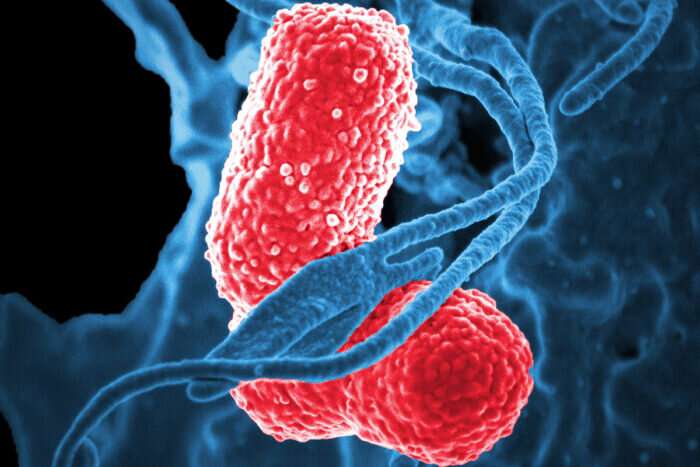
Researchers at McMaster University have discovered a new antibiotic that kills some of the world’s most dangerous and drug-resistant bacteria—and does so by targeting a previously unknown vulnerability, opening the door to an entirely new class of treatments. The new compound, called manikomycin, was identified by a team led by McMaster Professor Gerry Wright and has shown early effectiveness against priority pathogens including Salmonella, E. coli, and Klebsiella.
A new way to hit bacteria
Unlike any antibiotic currently used in clinics, it works by blocking the exit site of the ribosome, the protein-producing machinery found inside every bacterial cell. The discovery, published in Nature, marks the fourth new antibiotic candidate from Wright’s lab in just over a year, underscoring a promising new approach to drug discovery at a time when antibiotic resistance is a growing global threat.
“Not a single antibiotic prescribed in clinics today does what manikomycin does,” says Wright, a member of the Michael G. DeGroote Institute of Infectious Disease Research. “Not azithromycin, not tetracycline—none of them. So, we’ve not only found a brand-new drug candidate, but we’ve also established a brand-new target in bacteria that could potentially be exploited with other new drugs.”

It’s the latter part of the discovery that has researchers most excited. Wright notes that because most antibiotics used today target the same handful of vulnerabilities on the ribosome, bacteria have evolved broad defense strategies against such attacks; however, drugs that attack a different part of the ribosome—the exit site—leave them defenseless.
“Even newly discovered drugs that attack those same old targets may quickly face resistance,” says Wright, a professor in McMaster’s Department of Biochemistry and Biomedical Sciences. “But, over the history of medicine, we’ve put absolutely no selective pressure on this particular target, so bacteria have no existing resistance mechanisms for manikomycin.”
Wright likens the ribosome to a factory assembly line. Finished components, he says, must be moved off of the line before the next piece can advance. Manikomycin blocks the exit lane, causing the entire assembly process to jam and eventually grind to a halt. Without the ability to produce proteins, bacteria cannot survive.
Mining an old microbe anew
The discovery of manikomycin builds on work that began more than 75 years ago, when scientists first discovered that the soil bacterium Streptomyces rimosus produced oxytetracycline, a powerful new drug that would help usher medicine into the antibiotic age.
While the breakthrough was one of several similar discoveries made in the mid-1900s, S. rimosus and related bacteria have long since been abandoned as a potential source of new antibiotics.
“There is an overwhelming perception in science that these bacteria have been mined completely dry—that we’ve found all there is to find,” Wright says. “Our lab has found that this is not at all the case.”
Using fractionation to find hidden drugs
Wright’s group, working with collaborators at the University of Illinois Chicago and the University of Hamburg in Germany, used an advanced laboratory technique called fractionation to uncover the new antibiotic. By filtering out oxytetracycline and other abundant compounds from the chemical mixtures produced by S. rimosus, the researchers were able to isolate scarcer molecules that had gone unnoticed over the years.
Manpreet Kaur, a postdoctoral fellow in Wright’s lab and first author on the new study, says that finding a viable new drug candidate this way signals new opportunities for antibiotic discovery.
“There is likely so much still to be discovered through fractionation,” says Kaur. “Revisiting the extracts of even-well studied bacteria like Streptomyces may lead to similar discoveries in the future.”
Next steps toward the clinic
Wright’s team is now advancing manikomycin toward clinical development. They have already shown that the new antibiotic is not toxic to human cells, and that it works well in a lab-controlled model of infection—both key milestones on the early development pathway.
They are now working on optimizing the drug’s “residency time”—how long it stays active in the body—and have produced 60 different derivatives with plans to push the best one forward.
“We’re excited about this molecule’s potential,” Wright says. “There’s a clear path forward, and we may even be able to expand its spectrum so that it eventually affects even more bacteria, too.”
Publication details
Gerard Wright et al, A natural depsipeptide antibiotic binds the E-site of the bacterial ribosome, Nature (2026). DOI: 10.1038/s41586-026-10589-2
Journal information:
Nature
Key medical concepts
Clinical categories
The content is provided for information purposes only.