

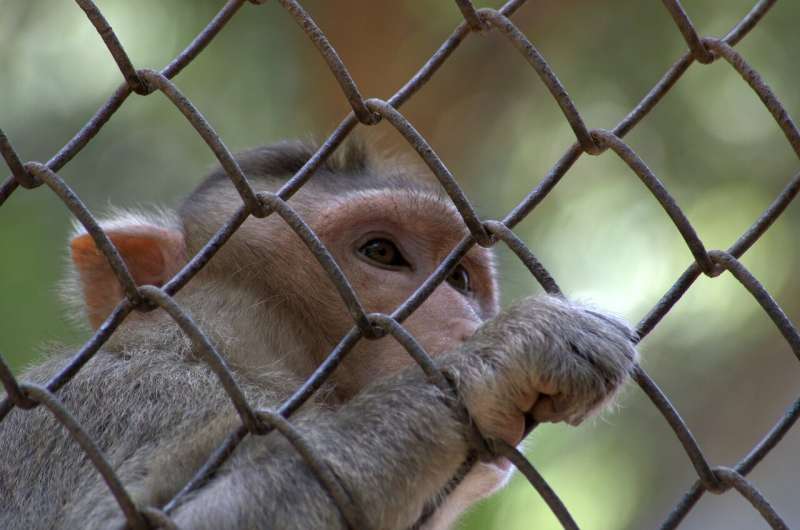
It is not unusual for laboratory monkeys to engage in abnormal repetitive behaviors (ARBs), such as pacing and hair-plucking. Conventional thinking is that these actions are linked to recent stresses or current housing conditions. But a new study published in the journal Biology Letters suggests the causes are often cumulative negative experiences that build up over an animal’s entire life.
Tracking lifetime stresses
To test this, scientists examined the life histories of 240 rhesus macaques living at two US research centers. They identified 12 types of negative experiences, including current stressors like being alone in a cage and past stressors such as being taken from their mother too early or undergoing medical procedures.
Each monkey was given a score based on how many of these 12 events they had experienced. The higher the score, the more negative experiences a monkey had endured throughout its life.
The team also set up video cameras to monitor the monkeys for several days to see how often they performed these abnormal, repetitive behaviors and whether they matched their life score.
The study revealed that the monkeys with the highest scores were more likely to show abnormal behaviors. In general, as the number of negative experiences increased in an animal’s life, so did the frequency of the behaviors. “Pooled ARB increased with lifetime negative experience scores in a dose-response type manner,” wrote the study authors in their paper.
Different types of stress were linked to distinct behaviors. For example, hair-plucking was closely tied to current stress, while pacing or rocking were more closely related to past negative events.
The researchers also noted a difference in the results between the two research centers. At one facility, past and current stresses predicted behaviors, while at the other, past experiences were the main driver, even if the monkey’s current situation seemed better. “ARBs can reflect the cumulative impact of the number and severity of negative experiences (both past and present).”
Non-invasive ways to gauge animal welfare
Because these behaviors indicate that an animal has had a difficult life or endured many stressful events, the researchers suggest their findings can serve as welfare indicators to assess the overall quality of life. This includes supporting the idea that there should be a limit on how many different experiments one animal can be used in.
Also, if an animal shows a high number of these behaviors, it could be a sign they should be retired from research.
Beyond monkeys, the team hopes the study will encourage similar research into the life histories of other captive animals, such as farm, zoo and working animals.
Written for you by our author Paul Arnold, edited by Gaby Clark, —this article is the result of careful human work. We rely on readers like you to keep independent science journalism alive.
If this reporting matters to you, please consider a donation (especially monthly). You’ll get an ad-free account as a thank-you.
Publication details
Georgia Mason et al, Ethological scars? Exposure to multiple negative events over a lifespan may predict abnormal repetitive behaviour in laboratory-housed rhesus macaques, Biology Letters (2026). DOI: 10.1098/rsbl.2025.0638
Key concepts
The content is provided for information purposes only.