

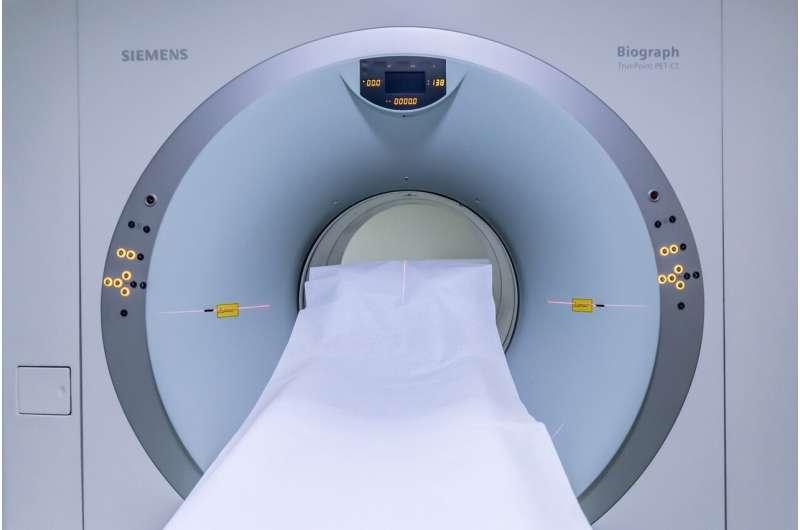
A research team led by Professor Wang Hongzhi from the Hefei Institute of Physical Science of the Chinese Academy of Sciences has developed a multi-stage, dual-domain, progressive network with synergistic training for sparse-view computed tomography (CT) reconstruction. The study is published in Neural Networks.
Sparse-view CT aims to reduce patient radiation exposure and shorten scanning time by decreasing the number of projection angles. However, this reduction often introduces severe streak artifacts that compromise diagnostic reliability. Conventional deep learning-based methods usually necessitate distinct models for various view conditions, leading to inefficient workflows and limited adaptability.
In this study, the researchers proposed a synergistic multi-stage dual-domain progressive reconstruction framework (MDPRNet) that introduces two key innovations.
First, the multi-view synergistic training strategy groups the data into ultra-sparse and sparse views, allowing a single unified model to adapt to a wide range of sampling conditions. This strategy effectively reduces performance discrepancies between view intervals and ensures stability under extremely sparse scenarios.
Second, the multi-stage dual-domain progressive architecture combines features from both sinogram and image domains, while a Cross-stage Feature Adapter with attention modules enhances feature fusion and progressively improves reconstruction quality.
When validated on public and self-built CT datasets, MDPRNet outperformed existing methods consistently and maintained high reconstruction accuracy and robustness under all sparse-view conditions.
“Our model solves the problem of adapting to different sparse-view settings,” said Prof. Wang, “It greatly improves reconstruction accuracy and generalization.”
More information
Jingyuan Shao et al, Multi-stage dual-domain progressive network with synergistic training for sparse-view CT reconstruction, Neural Networks (2026). DOI: 10.1016/j.neunet.2025.108221
Key medical concepts
CT Scansoccurrence of exposure to ionizing radiation at unspecified place
Clinical categories
The content is provided for information purposes only.