

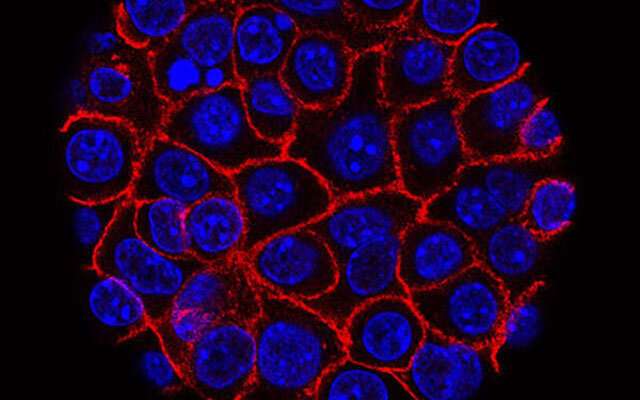
Current drugs for pancreatic cancer lose effectiveness within months because the tumor becomes resistant. Now, a group from Spain’s National Cancer Research Centre (CNIO) has been able to avoid the development of resistance in animal models with a combined triple therapy. Mariano Barbacid, head of the Experimental Oncology Group at the CNIO, has designed a therapy that successfully eliminates pancreatic tumors in mice completely and durably, with no significant side effects.
The study is published in the journal Proceedings of the National Academy of Sciences, with Carmen Guerra as co-lead author and Vasiliki Liaki and Sara Barrambana as first authors.
“These studies open the road to designing novel combination therapies that may improve the survival of PDAC patients [pancreatic ductal adenocarcinoma—the most common type of pancreatic cancer],” the authors state. “These results set the course for developing new clinical trials.”
Eliminating resistance to treatment
The first drugs aiming molecular targets for pancreatic cancer were approved in 2021, after half a century with no improvements over conventional chemotherapy. These new drugs block the action of KRAS, a gene mutated in 90% of people with pancreatic cancer. However, their effectiveness is modest, as the tumor becomes resistant after a few months.
The issue of resistance to KRAS inhibitor drugs is addressed in the new study by Barbacid, a pioneer in both KRAS research and the development of animal models for pancreatic cancer.
The strategy pursued by the CNIO group has been to block the action of the oncogene KRAS at three points, instead of just one—it is harder for a beam to break if it is fixed to the ceiling at three points, rather than just one. And indeed, after genetically eliminating three molecules from the KRAS signaling pathway in mouse models, the tumors disappeared permanently.
Targeting three links in the chain
Applying the same strategy in patients involves searching for drugs that block the KRAS molecular pathway at the same three points. The team employed a triple therapy, which combined an experimental KRAS inhibitor (daraxonrasib) with an approved drug for certain lung adenocarcinomas (afatinib) and a protein degrader (SD36).
The treatment was applied to three mouse models of pancreatic ductal adenocarcinoma, and in all of them, a significant and lasting regression of these experimental tumors was induced without causing significant toxicities, state the authors.
“This study describes a triple combination therapy […] that induces the robust regression of experimental PDACs and avoids the onset of tumor resistance. This triple combination is well tolerated in mice.”
Moving towards a clinical trial, but not yet
Regarding the next steps, Barbacid explains, “It is important to understand that, although experimental results like those described here have never been obtained before, we are still not in a position to carry out clinical trials with the triple therapy.”
The authors emphasize that optimizing the triple combination therapy for use in a clinical setting will not be easy. “(..) Despite the current limitations, these results could open the door to new therapeutic options to improve the clinical outcome of patients with pancreatic ductal adenocarcinoma in the not too distant future.”
Publication details
Vasiliki Liaki et al, A targeted combination therapy achieves effective pancreatic cancer regression and prevents tumor resistance, Proceedings of the National Academy of Sciences (2025). DOI: 10.1073/pnas.2523039122
Journal information:
Proceedings of the National Academy of Sciences
Clinical categories
The content is provided for information purposes only.