

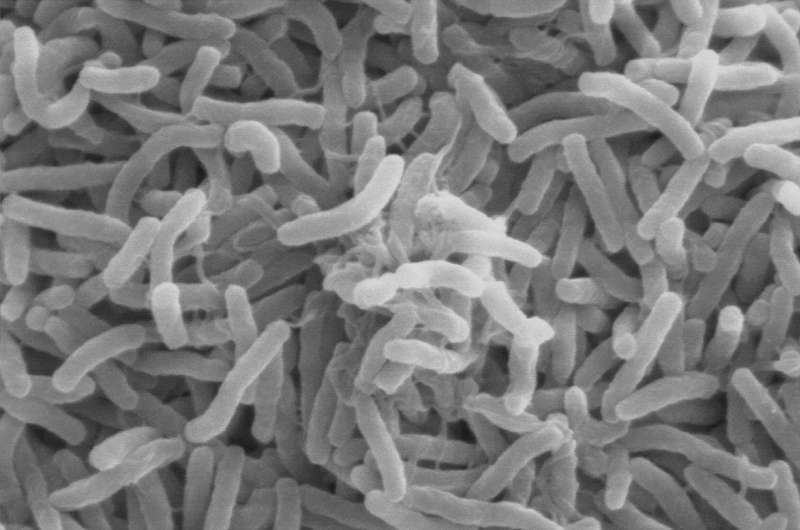
Like most bacteria, Vibrio cholerae lives under constant attack from viruses. To survive, bacteria equip themselves with antiviral immune systems. Previous work has shown that V. cholerae carries a large genetic element called a sedentary chromosomal integron (SCI). This structure contains hundreds of small mobile DNA units known as “gene cassettes” arranged in a long array, like a chain of pearls.
While the function of many cassettes remains unknown, about 10% encode antiviral immune systems. However, most of these genes are located far from the start of the array and remain silent. Prevailing models propose that cassettes could be internally reshuffled to activate them, yet no such rearrangements have been observed in the pandemic lineage of V. cholerae for more than sixty years.
This raises a key question: if internal reshuffling is rare, how are cassette-encoded immune systems activated, and how do new cassettes enter the array at all?
To address this question, a team led by Melanie Blokesch at the Laboratory of Molecular Microbiology at EPFL has investigated whether the SCI might capture gene cassettes from genetic material entering the cell from the outside. The team’s study in Science provides insight.
Testing DNA uptake in the lab
A key feature of this process is natural competence, the ability of bacteria to take up free DNA from their surroundings. V. cholerae becomes naturally competent when it grows on chitinous surfaces, a polymer found in the shells of crustaceans that is abundant in aquatic environments.
In the laboratory, the team mimicked these conditions by growing bacteria on chitin and supplying DNA from different Vibrio cholerae strains or from other Vibrio species. They then tracked whether newly acquired gene cassettes were inserted into the first position of the SCI array.
Horizontal transfer takes the lead
In their work, the researchers show that V. cholerae can efficiently acquire new SCI gene cassettes from extracellular DNA. In aquatic habitats, DNA is released when bacterial cells are killed by viruses, antimicrobial compounds, or bacterial weapons. Nearby competent bacteria can take up this DNA and incorporate selected fragments into their own SCI.
“A loose comparison would be: Imagine your grandmother passes away, and—as a farewell gift—hands over the immunity she built up against the Spanish flu a century ago, immediately protecting you from that same virus. Wouldn’t that be amazing? This is essentially what we show that V. cholerae can do,” says Blokesch.
The team also showed that cassettes inserted in this position are functional. Several defense systems provide protection against viruses that infect Vibrio species, known as vibriophages.
A static pandemic lineage
An important exception emerged. In the pandemic 7PET lineage of V. cholerae, the SCI appears largely static. The authors propose that this reflects adaptation to a human-associated niche. However, if pandemic strains were to encounter environmental conditions that enable SCI cassette acquisition, they could expand their antiviral defenses.
“This possibility matters because vibriophage-based approaches are currently being explored to prevent cholera in endemic regions, and such evolutionary flexibility could ultimately affect how effective these strategies remain,” says Blokesch.
Publication details
Laurie Righi et al, Competence-mediated DNA uptake diversifies Vibrio cholerae sedentary chromosomal integrons, Science (2026). DOI: 10.1126/science.aed0645
Provided by
Ecole Polytechnique Federale de Lausanne
The content is provided for information purposes only.