

Shoulder Push-Up Workout
This shoulder-focused push-up routine is designed to build strength and stability using targeted variations.
Anatomy Of The Shoulders
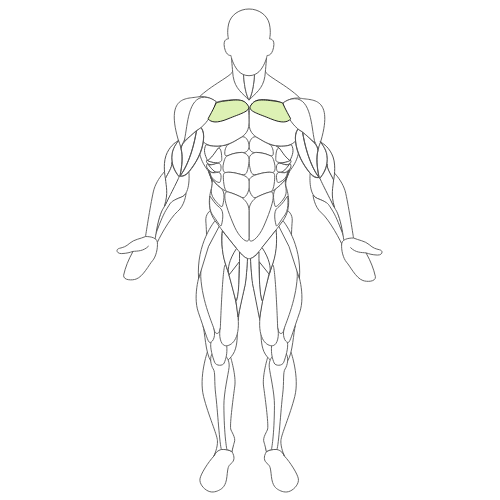
Clavicular Head of Pectoralis Major
Muscles located at the top of your chest, running from your armpit to collar bone. Smaller portion of your chest muscle.
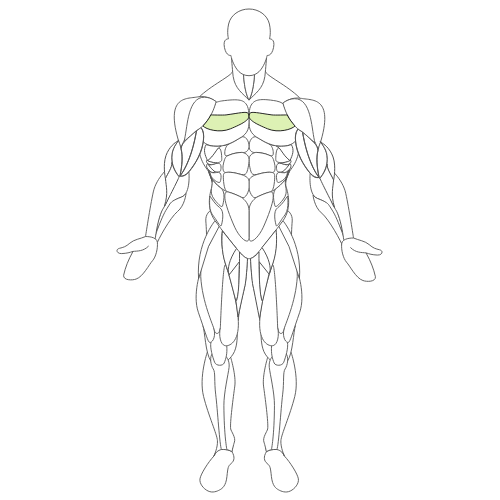
Sternal Head of Pectoralis Major
Large muscles located underneath your clavicle head. Makes up most of your chest area
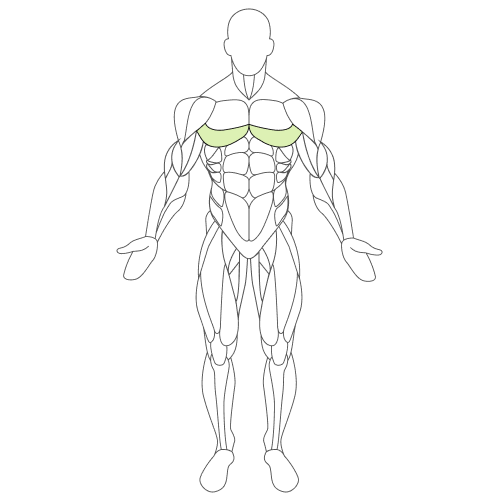
Abdominal Head of Pectoralis Major
Muscles located at the bottom of your pectoral region, just above your abdominal muscles.
The shoulder musculature is complex and includes several key muscle groups such as the rotator cuff, serratus anterior, and deltoids.
These muscles play a crucial role in everyday movements like lifting, reaching, and pushing. Strengthening them with the best push-ups for shoulders can improve functional performance, support upper-body stability, and reduce injury risk in daily tasks.
Research shows that shoulder muscles can reach up to 40%–50% of their maximum voluntary contraction during push-up exercises. This highlights how effective well-structured push-up variations are in targeting shoulder development.
Serratus Anterior
The serratus anterior plays a key role during push-ups for the shoulders.
It wraps around the ribcage and connects to the shoulder blades, helping stabilize the scapula and assist in bringing the shoulder blades together, supporting movements like pushing, pulling, and lifting.
During these exercises, it activates to lengthens the upper arms and retracts the shoulder blades. This activation improves shoulder mobility and lowers the risk of shoulder injuries.
Deltoid Muscles
The deltoid is a large muscle that forms the rounded outer part of the shoulder. It is made up of three heads: rear, front, and middle.
This muscle helps lift the arm, move it away from the body, and extend it forward. These movements are essential for reaching, pressing, and stabilizing during training. Adding deltoid strengthening exercises to your workouts can improve control, mobility, and shoulder endurance.
The deltoids play a major role in deltoid push-up exercises by supporting the shoulder and elbow joints and helping maintain proper alignment. They also assist the triceps to control upper arm movement, which reduces joint strain and helps prevent injury.
Rotator Cuff Muscles
The rotator cuff muscles are a group of smaller muscles that control shoulder rotation and provide joint stability during daily movements. They help with common tasks like putting on clothes or reaching for something overhead.
These muscles play an important role in many shoulder push-up variations, working together to stabilize the joint during each rep. Strengthening them through controlled bodyweight movements can increase shoulder flexibility and reduce the risk of overextension or injury.
Benefits Of Push-Ups For Shoulders
Read on for some of the main benefits you can gain by adding push-ups for your shoulders to your training routine.
Builds Strength
These push-up variations help build the shoulders, triceps, and chest by applying targeted, compound resistance. This method supports shoulder strength calisthenics by activating multiple muscle groups at once, leading to better overall upper-body development.
This type of training can also strengthen the rotator cuff with bodyweight movements, making the shoulder joint more stable and less prone to injury.
Having strong shoulders is essential for everyday activities like lifting, pushing, and carrying. These exercises also carry over to other lifts that rely on similar movement patterns, such as rows, chest presses, and deadlifts.
Improves Flexibility

Push-up variations that involve full arm extension and active shoulder control can help improve mobility across the upper body. These movements stimulate the shoulder joint, especially during the upward phase, encouraging a greater range of motion.
Many of these push-ups also engage the muscles around the shoulder blades, making them effective scapular stability exercises. This improves coordination and control through the upper back, which supports more fluid and injury-resistant movement.
Exercises like the Hindu push-up go a step further by stretching the spine and abdominals, contributing to improved posture and flexibility through the torso. Incorporating these into your routine supports overall flexibility in the shoulders, triceps, spine, and core, all while reinforcing key stabilizing muscles.
Tones Muscles
Push-ups for the shoulders are a great way to tone and shape the upper body. They’re especially useful for enhancing definition in the deltoids, making them ideal push-ups for shoulder definition.
Because these movements engage the shoulders through different angles, they also serve as effective shoulder muscle activation push-ups, helping you build control and symmetry with each rep.
When performed consistently, they can support muscle hypertrophy, which contributes to fuller, more defined muscles over time.
Tips To Make The Most Of A Calisthenics Shoulder Workout
- Always warm up your shoulders and upper arms before starting. Dynamic movements like arm circles can help activate the muscles and increase mobility.
- Focus on proper push-up form for shoulder gains. Keep your elbows tucked and upper arms still. Engage your shoulder muscles with intention during each rep to maximize results.
- Move with control. Avoid rushing or using momentum, which reduces effectiveness and increases injury risk.
- For advanced variations like handstand push-ups, use a wall for support or get help from a fitness professional to ensure safety.
- Keep your core tight and maintain a neutral spine. Avoid arching or rounding your back to protect your neck and lower back.
- Protect your wrists by avoiding hyperextension. Keep your hands aligned with your forearms to reduce strain and prevent joint discomfort.
Conclusion
Push-ups for shoulders are a powerful way to build strength, improve mobility, and enhance the overall shape of your upper body. Strong shoulders support functional movement and contribute to a more balanced, sculpted appearance.
Following a consistent shoulder-focused push-up routine can help you develop muscular control, joint stability, and definition using nothing but your bodyweight. With the right approach to bodyweight shoulder training, these simple yet effective exercises become a cornerstone for long-term progress and performance.
Frequently Asked Questions
All of the push-up variations we’ve covered deliver targeted shoulder activation, making them ideal for an effective upper-body routine. For a great home workout for shoulders, try the pike push-up, handstand push-up, spider push-up, and T push-up. Each offers a slightly different stimulus for well-rounded development.
These shoulder push-ups are more demanding because they shift emphasis away from the chest and place greater load on the deltoids. That extra effort makes them feel tougher, especially for those not used to isolating shoulder strength in bodyweight training.
It depends on your fitness level and goals, but a solid starting point for strength and growth is 3 to 5 sets of 4 to 6 reps. As you build control and power, gradually increase your volume to continue seeing results.
It’s not recommended to repeat the same shoulder-focused routine daily, as it can lead to overuse and fatigue. Give yourself 48 to 72 hours between sessions to allow for muscle recovery and rebuild. This rest is essential for progress, especially in a home workout for shoulders setting where recovery often gets overlooked.
Resources
Endomondo.com refrains from utilizing tertiary references. We uphold stringent sourcing criteria and depend on peer-reviewed studies and academic research conducted by medical associations and institutions. For more detailed insights, you can explore further by reading our editorial process.
- McCausland (2023). Anatomy, Shoulder and Upper Limb, Shoulder Muscles. [online] Available at: https://pubmed.ncbi.nlm.nih.gov/30521257/ [Accessed 27 Sep. 2024].
- Gentil, P., Soares, S. and Bottaro, M. (2015). Single vs. Multi-Joint Resistance Exercises: Effects on Muscle Strength and Hypertrophy. Asian Journal of Sports Medicine, [online] 6(1). doi:https://doi.org/10.5812/asjsm.24057.
- Cuéllar, R., Miguel Angel Ruiz-Ibán and Adrián Cuéllar (2017). Anatomy and Biomechanics of the Unstable Shoulder. The Open Orthopaedics Journal, [online] 11(1), pp.919–933. doi:https://doi.org/10.2174/1874325001711010919.
- Park, H.-K., Jung, M.-K., Park, E., Lee, C.-Y., Jee, Y.-S., Eun, D., Cha, J.-Y. and Yoo, J. (2018). The effect of warm-ups with stretching on the isokinetic moments of collegiate men. Journal of Exercise Rehabilitation, [online] 14(1), pp.78–82. doi:https://doi.org/10.12965/jer.1835210.605.
- Landin, D., Thompson, M. and Jackson, M. (2018). Functions of the Triceps Brachii in Humans: A Review. Journal of Clinical Medicine Research, [online] 10(4), pp.290–293. doi:https://doi.org/10.14740/jocmr3340w.
- Afonso, J., Ramirez-Campillo, R., João Moscão, Rocha, T., Zacca, R., Martins, A., Milheiro, A.A., Ferreira, J., Sarmento, H. and Filipe Manuel Clemente (2021). Strength Training versus Stretching for Improving Range of Motion: A Systematic Review and Meta-Analysis. Healthcare, [online] 9(4), pp.427–427. doi:https://doi.org/10.3390/healthcare9040427.
- Wilk, M., Zajac, A. and Tufano, J.J. (2021). The Influence of Movement Tempo During Resistance Training on Muscular Strength and Hypertrophy Responses: A Review. Sports Medicine, [online] 51(8), pp.1629–1650. doi:https://doi.org/10.1007/s40279-021-01465-2.
- Mendez-Rebolledo, G., Morales-Verdugo, J., Orozco-Chavez, I., Assis, F., Eleazar Lara Padilla and José, F. (2020). Optimal activation ratio of the scapular muscles in closed kinetic chain shoulder exercises: A systematic review. Journal of Back and Musculoskeletal Rehabilitation, [online] 34(1), pp.3–16. doi:https://doi.org/10.3233/bmr-191771.
- None Krzysztofik, Wilk, N., None Wojdała and None Gołaś (2019). Maximizing Muscle Hypertrophy: A Systematic Review of Advanced Resistance Training Techniques and Methods. International Journal of Environmental Research and Public Health, [online] 16(24), pp.4897–4897. doi:https://doi.org/10.3390/ijerph16244897.
- Kotarsky, C.J., Christensen, B.K., Miller, J.S. and Hackney, K.J. (2018). Effect of Progressive Calisthenic Push-up Training on Muscle Strength and Thickness. The Journal of Strength and Conditioning Research, [online] 32(3), pp.651–659. doi:https://doi.org/10.1519/jsc.0000000000002345.
- Behnam Liaghat, Julie Rønne Pedersen, Rasmus Skov Husted, Lisbeth Lund Pedersen, Thorborg, K. and Juhl, C.B. (2022). Diagnosis, prevention and treatment of common shoulder injuries in sport: grading the evidence – a statement paper commissioned by the Danish Society of Sports Physical Therapy (DSSF). British Journal of Sports Medicine, [online] 57(7), pp.408–416. doi:https://doi.org/10.1136/bjsports-2022-105674.
- Smita Maruvada, Madrazo-Ibarra, A. and Varacallo, M. (2023). Anatomy, Rotator Cuff. [online] Nih.gov. Available at: https://www.ncbi.nlm.nih.gov/books/NBK441844/ [Accessed 27 Sep. 2024].
- Afonso, J., Ramirez-Campillo, R., João Moscão, Rocha, T., Zacca, R., Martins, A., Milheiro, A.A., Ferreira, J., Sarmento, H. and Filipe Manuel Clemente (2021). Strength Training versus Stretching for Improving Range of Motion: A Systematic Review and Meta-Analysis. Healthcare, [online] 9(4), pp.427–427. doi:https://doi.org/10.3390/healthcare9040427.
- Doherty, R., Madigan, S.M., Nevill, A., Warrington, G. and Ellis, J.G. (2021). The Sleep and Recovery Practices of Athletes. Nutrients, [online] 13(4), pp.1330–1330. doi:https://doi.org/10.3390/nu13041330.