

How To Integrate These Exercises Into Your Workout Routine
Our nine glute day alternatives offer several functional benefits when included in a glute workout routine. However, you don’t need to perform them all at once to manage your training volume better. To help with this, we’ve programmed some of the best ones into a well-rounded glute workout.
We’ve started with some weighted glute isolation exercises before moving onto key bodyweight movements. Together, these exercises target all three of the glute muscles, especially the gluteus medius and minimus. Most of the exercises can also be performed using a machine, weights, or with just bodyweight.
Use the workout below as a general guide when planning your next glute workout, including them alongside your main movements. Feel free to swap any of them as needed, depending on your time and equipment.
Anatomy Of The Glutes
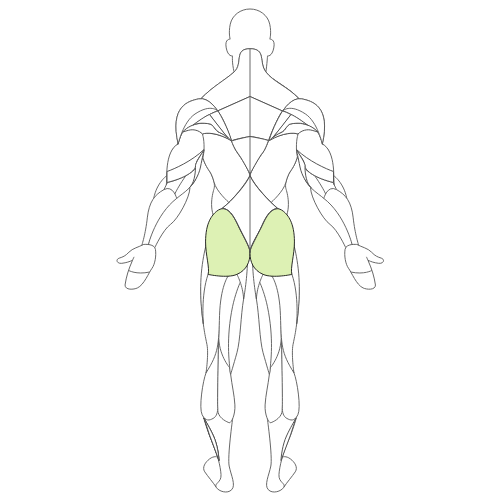
Gluteus
Large, superficial muscles located at your buttocks just below your lower back area.
The gluteus muscles primarily act on the hip joint. This is where the thigh bones meet the pelvis. They perform hip extension, abduction, and rotation, making them important for movement, stability, and power development.
Common glute exercises, such as back squats and hip thrusts, primarily use the glutes to perform hip extension. Research shows that both these movements activate the gluteus maximus at over 53% and 75% of a muscle contraction, respectively.
These are important to include as part of a complete glute routine. However, they place less focus on the equally important gluteus medius and minimus muscles. Therefore, performing them to build round glutes can ensure better function and power development.
Our underrated butt exercises focus primarily on the gluteus medius and minimus muscles. This means they involve hip abduction and hip rotation movements. We’ve also included some more common glute exercises at the start for well-rounded growth.
Gluteus Maximus
The gluteus maximus is the largest and most superficial of the three gluteal muscles. It’s located at the back of the pelvis, originating from the hip bone and inserting into the thigh bone.
Its primary function is to perform hip extension (bringing the thigh bone backward). It plays vital roles in movement, hip stability, and power generation.
Gluteus Medius
The gluteus medius muscles are underneath the gluteus maximus muscles. They originate from the hip bone and insert into the thigh bone. However, they’re located more laterally than the gluteus maximus.
Their functions include hip abduction, internal rotation, and external rotation. This means bringing the legs away from the midline and rotating the legs inwards and outwards, respectively.
The gluteus medius muscles are also crucial for hip stability during movement, preventing the pelvis from dipping to one side. Movement examples include walking, running, and most single-leg activities.
Use our gluteus medius exercises for targeted development of this muscle. These include a range of double and single-leg exercises.
Gluteus Minimus
The gluteus minimus muscles are the smallest and deepest of the gluteal muscles, sitting underneath the gluteus medius. While you can’t directly see them, you can feel them by pressing against the glutes.
They originate from the hip bone and insert into different parts of the thigh bone than the gluteus medius. Their primary functions are to perform hip abduction and internal hip rotation. Like the gluteus medius muscles, they’re also vital for pelvis stability in common movements such as walking and running.
Our gluteus minimus exercises can be used if you’re looking to isolate your gluteus minimus. These can be performed alongside gluteus maximus and gluteus medius movements.
Why Glute Activation Matters More Than You Think

These are the main benefits of the best glute exercises you’re not doing. We’ve discussed the meaning of each one, including its relation to our glute movements.
Improved Pelvic Stability
Pelvic stability refers to the ability of the pelvis to maintain a controlled position during movement. Activities requiring stability include running, walking, and lunging, all single-leg actions.
Poor pelvic control leads to suboptimal movement mechanics, increasing the risk of knee instability and hip discomfort.
Our underrated glute exercises primarily work the gluteus medius and minimus, both primary pelvic stabilizer muscles. These are particularly recruited during single-leg movements. Strengthening them via the exercises above can improve pelvic stability.
Better Movement Efficiency
Movement efficiency refers to the quality and overall limb control during activity and exercise. This includes movements such as jumping and squatting.
Poor movement efficiency can lead to repetitive stress injuries as the hips, knees, and lower back work to compensate. It can decrease the potential power output during athletic movements.
Better movement efficiency and correct muscle engagement ensure that the limbs and their joints move through their intended ranges. The gluteus medius and minimus muscles help guide hip positioning and leg alignment. Because of this, performing underrated glute exercises can improve movement control and coordination.
Enhanced Hip Strength And Balance
Hip joint strength refers to the ability of the hips to produce force and control movement. Hip balance is the ability of the different hip muscles to work together and ensure correct function and movement.
Weak and poorly balanced hips can cause excessive strain on the hip muscles and surrounding structures. This can lead to overuse injuries such as hip strains, hip bursitis, and piriformis syndrome.
Strengthening the smaller gluteus medius and minimus muscles helps improve the strength and balance during hip abduction and hip rotation. This can help balance them against the more dominant hip extension and hip flexor muscles. Dedicated gluteus medius and minimus work leads to better hip movement mechanisms, long-term health, and reduced injury risk.
Programming Tips For Glute Growth
- Prioritize The Correct Technique — While unique glute training techniques may look good, it’s important to stick to the science-backed technique cues. Proper technique assures efficient glute engagement and reduces injury risk. This also means you can avoid lower back pain during glute workouts.
- Use A Large Exercise Variety — This guarantees you work each of the glute muscles sufficiently. Dumbbell glute exercises may be used to fix glute imbalances. Bodyweight glute exercises may be used for higher volume training at home or in the gym. This may also include a resistance band glute workout for muscle activation through the full range of motion.
- Ensure Sufficient Training Intensity And Volume — Training intensity refers to the difficulty of exercise, while training volume is the amount of work performed. Both are key variables for glute muscle growth, or hypertrophy, to occur. Use sufficient training intensity and volume during each of your glute training sessions.
- Allow Enough Rest And Recovery — Rest and recovery are vital aspects of a well-rounded training routine. They allow energy levels to replenish and muscle growth to occur. Aim to allow at least 48 hours between glute training sessions.
Mistakes To Avoid When Training Glutes
These are the main mistakes to avoid when training your glutes. Take note of each, thinking about them next time you train.
- Poor Mind-Muscle Connection — Mind-muscle connection refers to the way you think about a muscle when working it. Ensure you think about working the glutes as you perform each exercise. This is a vital aspect for muscle growth.
- Not Implementing Progressive Overload — Progressive overload refers to the intentional manipulation of your training variables to ensure an adaptive response takes place. Remember to slowly increase your glute training volume and/or intensity to ensure the progressive overload principle is used.
- Using Momentum — If you swing or rush your glute repetitions, you’re limiting your time under tension and increasing injury risk. Perform each repetition using a controlled movement. This ensures that the glutes are acting as the primary movers.
- Neglecting Mobility Work — Having tight hip muscles can reduce potential glute engagement. Ensure you perform a suitable glute warm-up before each session to maximize efficiency.
Conclusion
Performing underrated glute exercises is vital to improve power generation, stability, and reduce injury risk. In terms of appearance, it can also improve glute symmetry.
Common exercises such as squats and hip thrusts certainly have their place. However, the underrated glute exercises presented in this article should be performed alongside them. This ensures all three glute muscles are properly developed.
Remember not to underestimate the power of well-developed glutes. Add these to your training routine and let us know about the changes you experience!
Frequently Asked Questions
Building your glutes from nothing requires a well-organized training approach and diet. Focus on high-volume glute isolation drills that target the glute muscles. Furthermore, a high daily protein intake provides the building blocks for glute growth.
A lazy glute, also known as dead butt syndrome, occurs when the gluteal muscles become underactive and weak. This happens through prolonged inactivity, especially long periods of sitting. The surrounding muscles may compensate, potentially causing discomfort and injury.
The 8-8-8 method is a training approach specifically designed for glute growth. It requires you to perform glute isolation exercises using three different variations. These are full-range repetitions, partial-range repetitions, and holding the squeeze at the top of the movement.
Squeezing the glutes at the top of the movement can help sculpt glutes with better engagement. However, it’s unlikely to cause significant growth. Prioritize glute activation movements with enough intensity and volume to ensure sufficient glute growth.
Resources
Endomondo.com refrains from utilizing tertiary references. We uphold stringent sourcing criteria and depend on peer-reviewed studies and academic research conducted by medical associations and institutions. For more detailed insights, you can explore further by reading our editorial process.
- Adel Elzanie and Borger, J. (2023). Anatomy, Bony Pelvis and Lower Limb, Gluteus Maximus Muscle. [online] Nih.gov. Available at: https://www.ncbi.nlm.nih.gov/books/NBK538193/ [Accessed 30 May 2025].
- Moore, D., Semciw, A.I. and Pizzari, T. (2020). A SYSTEMATIC REVIEW AND META-ANALYSIS OF COMMON THERAPEUTIC EXERCISES THAT GENERATE HIGHEST MUSCLE ACTIVITY IN THE GLUTEUS MEDIUS AND GLUTEUS MINIMUS SEGMENTS. International Journal of Sports Physical Therapy, [online] 15(6), pp.856–881. doi:https://doi.org/10.26603/ijspt20200856.
- Buckthorpe, M., Stride, M. and Villa, F.D. (2019). ASSESSING AND TREATING GLUTEUS MAXIMUS WEAKNESS – A CLINICAL COMMENTARY. International Journal of Sports Physical Therapy, [online] 14(4), p.655. Available at: https://pmc.ncbi.nlm.nih.gov/articles/PMC6670060/ [Accessed 30 May 2025].
- Neves, P.P., Alves, A.R., Marinho, D.A. and Neiva, H.P. (2021). Warming-Up for Resistance Training and Muscular Performance: A Narrative Review. IntechOpen eBooks. [online] doi:https://doi.org/10.5772/intechopen.96075.
- Sousa, C.A., Zourdos, M.C., Storey, A.G. and Helms, E.R. (2024). The Importance of Recovery in Resistance Training Microcycle Construction. Journal of Human Kinetics, [online] 91, pp.205–223. doi:https://doi.org/10.5114/jhk/186659.
- Neto, W.K., Soares, E.G., Vieira, T.L., Aguiar, R., Thiago Andrade Chola, de, V. and Gama, E.F. (2020). Gluteus Maximus Activation during Common Strength and Hypertrophy Exercises: A Systematic Review. Journal of Sports Science & Medicine, [online] 19(1), p.195. Available at: https://pmc.ncbi.nlm.nih.gov/articles/PMC7039033/ [Accessed 30 May 2025].
- Kenan Erdağı and Bülent Işik (2021). The Study of the Cross-Sectional Areas of the Gluteal Muscles on Magnetic Resonance Images of the… ResearchGate, [online] 3(23), pp.1–10. doi:https://doi.org/10.23751/pn.v23i3.12068.
- Akamatsu, F.E., Yendo, T.M., Rhode, C., Itezerote, A.M., Flávio Hojaij, Andrade, M., Hsing, W.T. and Jacomo, A.L. (2017). Anatomical Basis of the Myofascial Trigger Points of the Gluteus Maximus Muscle. BioMed Research International, [online] 2017, pp.1–5. doi:https://doi.org/10.1155/2017/4821968.
- Shah, A. and Bordoni, B. (2023). Anatomy, Bony Pelvis and Lower Limb, Gluteus Medius Muscle. [online] Nih.gov. Available at: https://www.ncbi.nlm.nih.gov/books/NBK557509/ [Accessed 30 May 2025].
- Kumar, S., Shilpa Mohanan, Ahamed Lazim Vattoth, Bajaj, G. and Pandey, T. (2023). Anatomy and Biomechanics of Lower Extremity Tendons: Imaging Implications. Seminars in Ultrasound CT and MRI, [online] 44(4), pp.364–385. doi:https://doi.org/10.1053/j.sult.2023.03.020.
- Greco, A.J. and Vilella, R.C. (2023). Anatomy, Bony Pelvis and Lower Limb, Gluteus Minimus Muscle. [online] Nih.gov. Available at: https://www.ncbi.nlm.nih.gov/books/NBK556144/ [Accessed 30 May 2025].
- Dimitriou, D., Meisterhans, M., Geissmann, M., Borpas, P., Hoch, A., Rosner, J., Schubert, M., Aguirre, J., Eichenberger, U. and Zingg, P.O. (2023). The effect of experimentally induced gluteal muscle weakness on joint kinematics, reaction forces, and dynamic balance performance during deep bilateral squats. Journal of Orthopaedic Research, [online] 42(1), pp.164–171. doi:https://doi.org/10.1002/jor.25644.
- Gallego-Izquierdo, T., Vidal-Aragón, G., Calderón-Corrales, P., Acuña, Á., Achalandabaso-Ochoa, A., Aibar-Almazán, A., Martínez-Amat, A. and Pecos-Martín, D. (2020). Effects of a Gluteal Muscles Specific Exercise Program on the Vertical Jump. International Journal of Environmental Research and Public Health, [online] 17(15), p.5383. doi:https://doi.org/10.3390/ijerph17155383.
- Neamatallah, Z., Herrington, L. and Jones, R. (2020). An investigation into the role of gluteal muscle strength and EMG activity in controlling HIP and knee motion during landing tasks. Physical Therapy in Sport, [online] 43, pp.230–235. doi:https://doi.org/10.1016/j.ptsp.2019.12.008.
- Hicks, B.L., Lam, J.C. and Varacallo, M.A. (2023). Piriformis Syndrome. [online] Nih.gov. Available at: https://www.ncbi.nlm.nih.gov/books/NBK448172/ [Accessed 30 May 2025].
- Kolber, M.J., Stull, K.R., Cheatham, S.W. and Hanney, W.J. (2017). The Influence of Hip Muscle Impairments on Squat Performance. Strength & Conditioning Journal, [online] 39(3), pp.66–73. doi:https://doi.org/10.1519/ssc.0000000000000305.
- Patroklos Androulakis Korakakis, Wolf, M., Coleman, M., Burke, R., Piñero, A., Nippard, J. and Schoenfeld, B.J. (2023). Optimizing Resistance Training Technique to Maximize Muscle Hypertrophy: A Narrative Review. Journal of Functional Morphology and Kinesiology, [online] 9(1), pp.9–9. doi:https://doi.org/10.3390/jfmk9010009.
- Androulakis Korakakis, P., Wolf, M., Coleman, M., Burke, R., Piñero, A., Nippard, J. and Schoenfeld, B.J. (2023). Optimizing Resistance Training Technique to Maximize Muscle Hypertrophy: A Narrative Review. Journal of Functional Morphology and Kinesiology, [online] 9(1), p.9. doi:https://doi.org/10.3390/jfmk9010009.
- Calatayud, J., Vinstrup, J., Jakobsen, M.D., Sundstrup, E., Brandt, M., Jay, K., Colado, J.C. and Andersen, L.L. (2015). Importance of mind-muscle connection during progressive resistance training. European Journal of Applied Physiology, [online] 116(3), pp.527–533. doi:https://doi.org/10.1007/s00421-015-3305-7.
- Vlad Adrian Geantă and Ardelean, V.P. (2021). Improving muscle size with Weider’s principle of progressive overload in non-performance athletes. Timisoara Physical Education and Rehabilitation Journal, [online] 14(27), pp.27–32. doi:https://doi.org/10.2478/tperj-2021-0011.
- Sarah C. Martinez-Sepanski, Angie Bowman and Ketlon Mehls (2024). The Effect of Hip Flexor Tightness on Muscle Activity during the Front Squat. International Journal of Strength and Conditioning, [online] 4(1). doi:https://doi.org/10.47206/ijsc.v4i1.259.