

A new study led by UCLA Health has shown that repetitive practice not only is helpful in improving skills but also leads to profound changes in the brain’s memory pathways.
The research, published in the journal Nature and co-led by Rockefeller University, sought to unravel how the brain’s ability to retain and process information, known as working memory, improves through training.
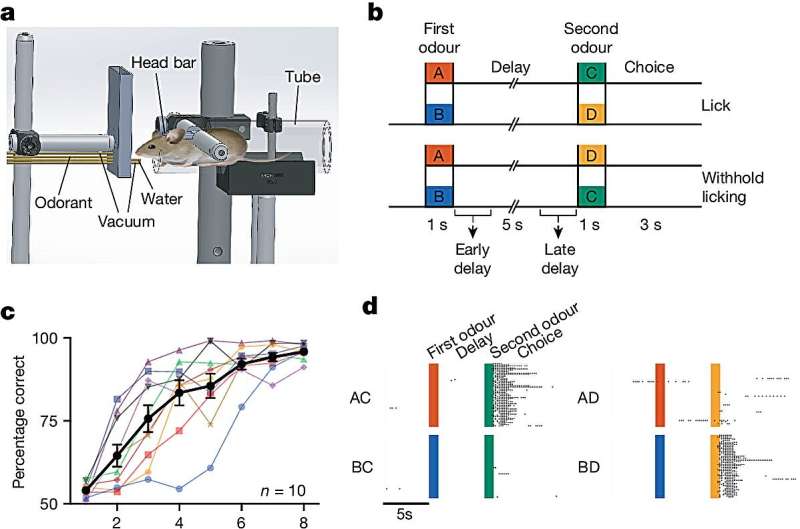
To test this, researchers tasked mice with identifying and recalling a sequence of odors over the course of two weeks. Researchers then tracked neural activity in the animals as they practiced the task by using a novel, custom-built microscope to image cellular activity in up to 73,000 neurons simultaneously throughout the cortex.
The study revealed a transformation in the working memory circuits located in the secondary motor cortex as the mice repeated the task through time. As the mice were first learning the task, the memory representations were unstable. However, after repeatedly practicing the task, the memory patterns began to solidify or “crystallize,” said corresponding author and UCLA Health neurologist Dr. Peyman Golshani.
“If one imagines that each neuron in the brain is sounding a different note, the melody that the brain is generating when it is doing the task was changing from day to day, but then became more and more refined and similar as animals kept practicing the task,” Golshani said.
These changes give insights into why performance becomes more accurate and automatic following repetitive practice.
“This insight not only advances our understanding of learning and memory but also has implications for addressing memory-related disorders,” Golshani said.
The work was performed by Dr. Arash Bellafard, project scientist at UCLA in close collaboration with Dr. Alipasha Vaziri’s group at Rockefeller University.
More information:
Arash Bellafard et al, Volatile working memory representations crystallize with practice, Nature (2024). DOI: 10.1038/s41586-024-07425-w
Citation:
The crystallization of memory: Study reveals how practice forms new memory pathways in the brain (2024, May 15)
crystallization-memory-reveals-pathways-brain.html
.
. The content is provided for information purposes only.