

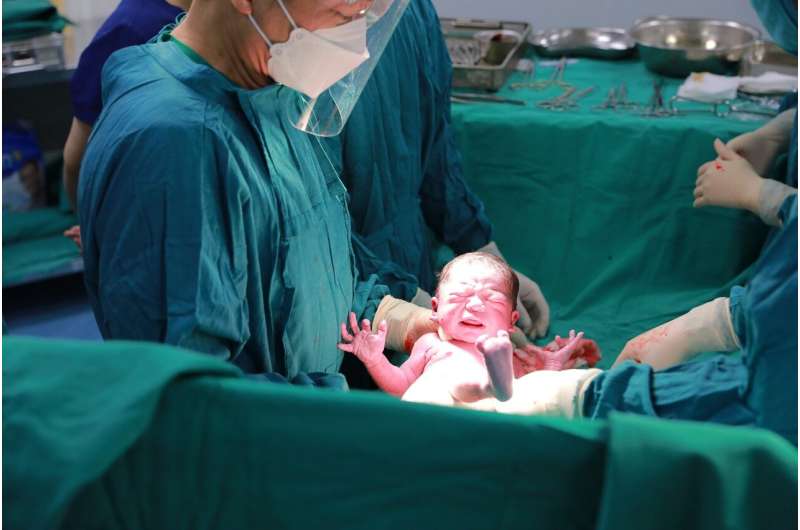
In a recently published review article from Lund University in the European Journal of Obstetrics & Gynecology and Reproductive Biology, researchers have analyzed the incidence of cesarean sections in different European countries. The results show that private hospitals in several countries have a higher proportion of cesarean sections than public hospitals, even among women in low-risk groups. The cesarean section rate varied from around 17% in northern Europe to more than 50% in southern Europe.
Cesarean sections are a life-saving procedure when there are medical reasons, such as with pelvic disproportion or if the health of the mother or child is at risk. However, for women in the low-risk group—i.e., healthy pregnant women without complications—vaginal birth is usually safer and better for both mother and child. Despite this, the number of cesarean sections is increasing sharply throughout Europe.
“We analyzed over 12 million births in 25 European countries between 2000 and 2025 by collecting data from previously published studies. To enable comparison, we used Robson’s ten-group classification, an international tool for categorizing women in labor based on five basic factors,” says Sara Ebadi, a doctoral student at Lund University and junior doctor in surgery at Ystad Hospital.
The Robson Ten Group Classification classifies all women who give birth in a hospital or health care system. The system is primarily used to analyze and compare cesarean section rates and is based on five basic factors:
- Pregnancy order (first child or previous birth)
- Number of fetuses (singleton or twin pregnancy)
- Fetal position (head position or breech position)
- Gestational age (full term or preterm)
- Onset of labor (spontaneous, induced, or cesarean section before delivery)
Of the births included in the systematic review, 32% took place in private hospitals. Southern Europe had the highest cesarean section rates at around 55%. Of all births occuring at private hospitals, nearly three-quarters were by cesarean section, which is a very high number.
The most striking difference between public and private hospitals was in the group of low-risk first-time mothers. They had the largest increase in the number of cesarean sections in privatized health care. The researchers believe that this indicates that non-medical factors—such as local routines, financial incentives or health care policy—can influence how often cesarean sections are performed. The women’s own wishes may also be a factor.
“I think many women are afraid of the unknowns surrounding vaginal birth, and at the same time they lack awareness of the serious consequences that a cesarean section can have. In privatized health care, they have a greater opportunity to request and pay for a cesarean section. The health care facility, in turn, also earns more financially from a surgical procedure than from a vaginal birth,” says Mehreen Zaigham, Associate Professor in Obstetrics and Gynecology at Lund University and specialist doctor at Skåne University Hospital.
In Sweden, we have a research-based, structured health care system for women who want a cesarean section. They first undergo an assessment by a midwife and, if necessary, are referred to specialist care, where a multi-professional team conducts a medical and psychological evaluation. Based on the woman’s perspective, risk factors and needs, an individual birth plan is then drawn up. Women at low risk are offered support and tools to manage their fear of childbirth and are encouraged to have a vaginal birth. This is one of the reasons for the lower cesarean section rate in Sweden—and also in the rest of the Nordic countries.
“Our goal with the study is to promote safe, patient-centered and evidence-based maternity care. The results can be used to develop guidelines and provide expectant parents with better information ahead of the birth, as well as to train health care staff to balance clinical indications with the patient’s wishes. The next step is to continue research into the long-term outcomes for mother and child with different birth methods,” concludes Zaigham.
More information
Sara Ebadi et al, Caesarean section rates in public vs private hospitals in Europe: a systematic review and meta-analysis using the Robson ten group classification system, European Journal of Obstetrics & Gynecology and Reproductive Biology (2026). DOI: 10.1016/j.ejogrb.2025.114921
Key medical concepts
The content is provided for information purposes only.